
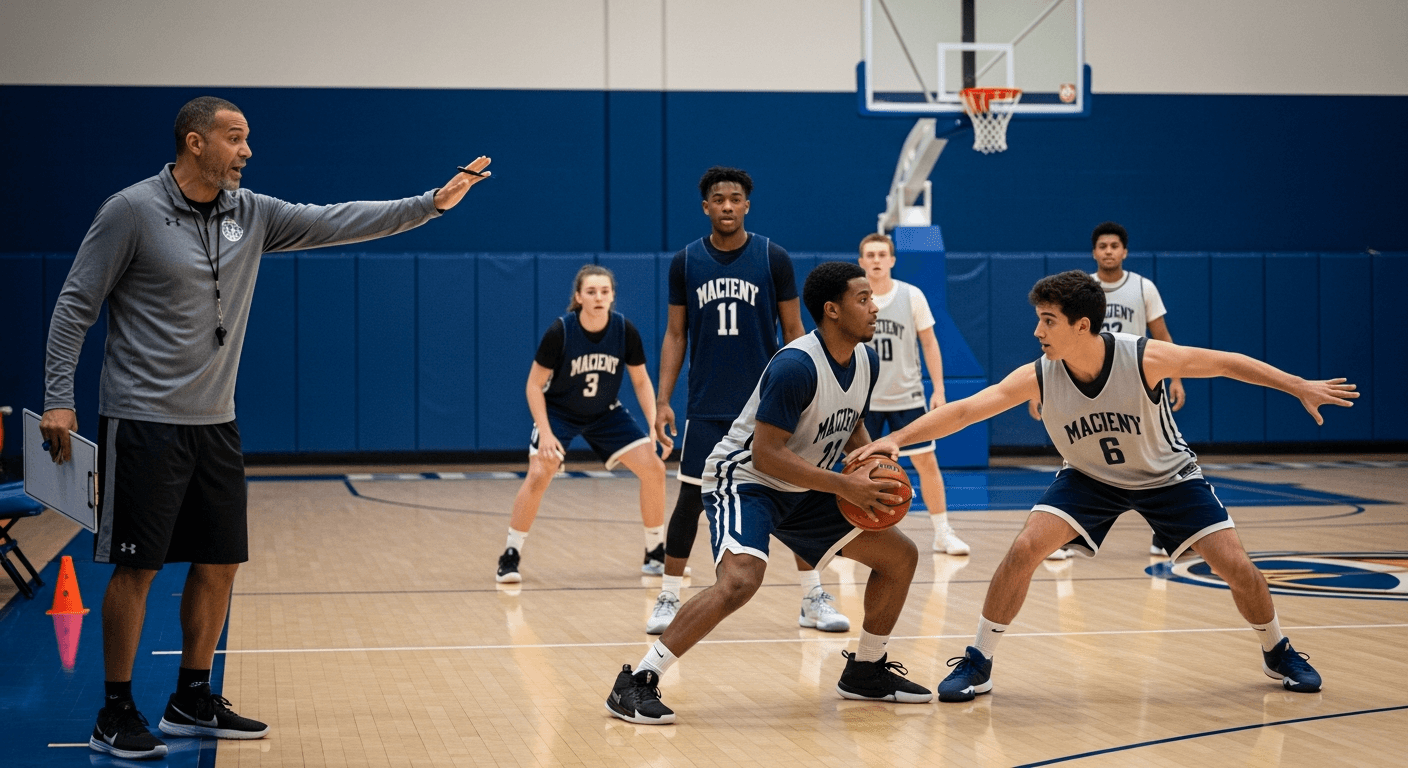
The Big Idea: “Basics” Aren’t Beginner Stuff—They’re the Universal Language of Basketball
When coaches say “we’ve got to get back to the basics,” it often sounds like a punishment: a rewind button for when the team isn’t “ready” for the fun stuff. But in basketball, the basics aren’t the bottom of the pyramid—they’re the concrete. Every level you’ll ever coach (and every level your players will ever reach) is built on the same small set of rules, habits, and decisions. The game just gets faster, more physical, and less forgiving.
Thesis: The fundamentals that transfer to every level are the ones that hold up under pressure—spacing, advantage creation, ball security, shot quality, and defensive communication. If you coach those as decision-making rules (not just “technique”), your team will look organized even when you’re not calling plays, even when the crowd is loud, and even when a player is having an off night.
Here’s one of my favorite coaching laws to keep us honest: “If it only works when it’s quiet, it doesn’t work.” Mid-season is when you stop collecting drills and start installing standards. The goal isn’t to “know” fundamentals. The goal is to default to them when tired, down six, or up eight with two minutes left.
The “Known Rules” Most Good Coaches Live By (And Why They Translate)
Basketball has official rules, but teams run on a second layer: shared agreements. These are the “known rules” that show up in every good program, whether they run motion, continuity, 5-out, 4-out-1-in, or a menu of sets.
Coaching Law: “Rules beat plays.” A play is a script; rules are a language. When a play breaks, rules keep you fluent.
Here are the core rules that transfer up levels:
- Spacing is non-negotiable. Bad spacing makes good players look average. Good spacing makes average players look playable.
- Paint touches matter. Whether it’s a post touch, a drive, or a cut that forces help—shots get easier when the defense collapses.
- 0.5 decisions. Catch and decide: shoot, drive, or move it. Holding the ball is a turnover that just hasn’t happened yet.
- Protect the ball with your body. High school defenders can’t guard what they can’t reach, and college defenders punish exposed dribbles.
- Defend the ball, defend the paint, finish the possession. On-ball pressure, help rules, and rebounding are the holy trinity.
- Talk early, talk often, talk specific. “I got ball,” “I’m low,” “Cutter,” “Screen left,” “Switch,” “Ice.” Noise isn’t communication.
Coaching Law: “Spacing creates time.” When you spread the floor correctly, defenders are late—and late defenders foul or give up layups.
What “Fundamentals” Actually Mean in a Mid-Season HS Gym
At the HS level, “fundamentals” can’t just be stationary ball-handling lines and form shooting (though those can have a place). Mid-season, your players already have habits—good and bad. Your job is to pressure-test the basics in game-like constraints.
Think of fundamentals as four buckets:
- Footwork fundamentals: pivots, jump stops, inside/outside foot on layups, drop steps, defensive slides, closeouts.
- Ball fundamentals: passing on time/target, catching ready, dribble protection, meeting passes.
- Space fundamentals: corners filled, 45s occupied, short corner understanding, cutting with purpose, replacing.
- Competitive fundamentals: sprinting in transition, first three steps on defense, box-outs, loose balls, next-play mentality.
Coaching Law: “Technique is what you do; fundamentals are what you do first.”
Coaching Cues You Can Actually Shout (And Players Can Actually Use)
Good cues are short, consistent, and tied to actions you can see. Here are cues that map to the transferable basics:
- “Corner stays filled!”
- “0.5—decide!”
- “Paint touch first!”
- “Chin it—strong!”
- “See two—pass!”
- “Hit first—box out!”
- “No middle!”
- “High hands—closeout!”
- “Talk early—talk loud!”
- “Next play—now!”
Pick 6–8 that match your identity and use them relentlessly. Coaching Law: “Your cue vocabulary becomes your team’s decision-making.”
Four to Six Drills That Teach the Real Basics (Not the Museum Version)
You’ve got 12–15 players, a court, and mid-season urgency. These drills are designed to teach fundamentals that survive game speed.
Drill 1: 0.5 Advantage Passing (4v4 Continuous)
Setup: 4v4 in the half court. One coach or manager at the top with a ball. Extra players rotate in. Put a 12-second shot clock (phone timer works).
How it works: Coach passes to an offensive player to start. Offense must make a decision within “0.5”: shoot, drive, or pass. No holding. If a player holds or jab-jab-jabs, it’s a turnover. Play live to a score or stop (coach’s choice). After a stop, new ball immediately to offense for continuous reps.
Coaching points:
- Teach players to catch with feet and eyes ready (shot pocket, elbows in).
- Reward “extra pass” threes and paint touches.
- Emphasize spacing rules: corners filled, 45s, and a dunker spot/short corner if you play 4-out-1-in.
- Defensively, demand talk: “ball,” “help,” “cutter,” “switch.”
Coaching Law: “Hesitation is a defensive win.”
Drill 2: Paint Touch Game (3v3 to 5)
Setup: 3v3 in the half court. Start at the top. Keep it simple: no set plays. Have two courts if possible to keep reps high with 12–15.
How it works: To score, a team must get a paint touch first (drive that gets two feet in the paint, post catch in the lane, or a cut catch in the paint). After a paint touch, any made basket counts. If you score without a paint touch, it doesn’t count (or it’s minus one—your choice).
Coaching points:
- Teach the difference between a “paint touch” and a reckless drive into a crowd.
- On drives, demand the kick-out read: if you see two, you pass.
- Off-ball players must “drift and fill” to windows (corner drift, 45 fill).
- Defensively, teach early help and recover—no ball-watching.
This game builds the habit that transfers: create advantage, then convert it.
Drill 3: Closeout-to-Contain (Shell Variant, 4v4)
Setup: 4 defenders in shell positions (two at elbows, two at blocks). 4 offensive players spaced (corners and wings). Coach starts with the ball and passes to an offensive player.
How it works: On the pass, defenders must close out with high hands, then contain the drive for 2–3 dribbles. Offense is allowed to attack immediately. Play for 8–10 seconds, then reset. Add scoring: defense gets a point for a stop without fouling; offense gets a point for a paint touch or made shot.
Coaching points:
- Closeout: sprint halfway, chop feet, high hands, nose on chest.
- Contain: “no middle” or your chosen rule; angle the ball to help.
- Help defenders: be early, be low, see ball and man.
- Finish: rebound. A great closeout that gives up an O-board is a bad possession.
Coaching Law: “Defense is a chain—your weakest link gets hunted.”
Drill 4: Transition Numbers with a Rule (3v2, 2v1, then 3v3)
Setup: Three offensive players at half court, two defenders under the rim. Coach with ball at half. Extra players line up to rotate.
How it works: Start 3v2 to the far basket. After the shot, the shooter and nearest two players sprint back and it becomes 2v1 the other way (or vice versa). Then flow into 3v3 with the next group joining. Add one rule: first pass must hit the wing or rim runner must touch the paint before a shot.
Coaching points:
- Teach lanes: wide wings, rim runner, and a safety.
- Ball handler: attack the top foot of the defender, force a commit.
- Passes: on time, to space, away from defenders.
- Defense: stop ball first, then match up—no complaining.
Coaching Law: “Transition is honesty.” Teams that loaf in practice will be exposed in games.
Drill 5: Rebound, Chin, Outlet (5-Man Rebound War)
Setup: 5 offensive players around the perimeter, 5 defenders inside. Coach shoots from different spots. Rotate groups if you have 12–15.
How it works: On the shot, defenders must box out, secure the rebound, chin the ball, pivot, and outlet to a guard spot. If the offense gets the rebound, it’s an automatic point for offense and they stay. Defense scores by securing and cleanly outletting three times in a row.
Coaching points:
- Box out is “hit-find-get,” not “watch-jump-hope.”
- Chin it strong—elbows out, ball to forehead, eyes up.
- Outlet: meet the pass, don’t wait for it.
- Guards: come back to the ball and talk (“Outlet! Outlet!”).
Coaching Law: “Rebounding is a decision before it’s a jump.”
Common Mistakes Coaches Make About “Basics” (And the Fix)
Most fundamental problems aren’t caused by ignorance. They’re caused by practice structure and mixed messages. Here are common mistakes that show up in HS mid-season, plus fixes you can apply tomorrow.
- Mistake: Teaching skills in isolation and expecting them to appear in games.
Fix: Add a defender, a clock, and a scoring rule. Make fundamentals survive contact and speed. - Mistake: Over-coaching every rep (constant stoppages).
Fix: Let 3–4 possessions play, then coach the pattern. Use quick “freeze” moments, then release. - Mistake: Confusing “running plays” with “good offense.”
Fix: Grade possessions by shot quality: paint touch, advantage, and spacing, not whether you got to the final option. - Mistake: Telling players to “move without the ball” without teaching where and why.
Fix: Install simple spacing rules: fill corners, replace to 45, cut through the paint, don’t stand in the dunker spot unless assigned. - Mistake: Allowing lazy catches (flat feet, ball below waist).
Fix: Demand “ready hands, ready feet.” If they aren’t ready, it’s a dead rep. - Mistake: Teaching “help defense” but not teaching recovery.
Fix: Drill help-and-recover footwork: stunt, slide back, high hands on closeout. - Mistake: Ignoring communication because it’s “hard to measure.”
Fix: Make talk a scoring category: defense gets points only if the possession includes 3 clear calls (“ball,” “screen,” “help”). - Mistake: Punishing turnovers without teaching decision rules.
Fix: Classify turnovers: forced vs unforced. Correct the unforced ones with rules (0.5, two-hand passes, jump stop in crowds). - Mistake: Letting the best player freelance while others follow rules.
Fix: Give stars freedom inside structure: “You can break a rule after you create an advantage.” - Mistake: Practicing at one speed, playing at another.
Fix: Build “speed ramps”: walk-through for spacing, then guided defense, then live with a clock.
Coaching Law: “You don’t rise to your best habits—you fall to your most rehearsed ones.”
Player Archetypes You’ll See (And How to Coach Each Without Losing the Team)
With 12–15 HS players, you’re coaching a small ecosystem. Fundamentals stick when each archetype feels seen—and challenged.
- The Talented Freelancer: Can get a shot anytime, sometimes at the cost of team spacing.
Coach it: Give them a rule-based mission: “Paint touch or touch-and-go pass before your pull-up.” Praise the right reads more than the makes. - The Anxious Role Player: Open but hesitant; passes up shots, dribbles into trouble.
Coach it: Simplify decisions: “Catch-shot if open; one-dribble drive if chased.” Celebrate quick decisions, not points. - The Tough Defender with Limited Offense: Valuable, but can clog spacing or rush finishes.
Coach it: Give them two offensive jobs: screen hard, sprint to dunker/short corner, crash selectively. Keep their role clean and proud. - The Basketball Nerd (High IQ, Average Tools): Sees actions early, may lack confidence to execute.
Coach it: Put them in advantage-creation roles (secondary ball handler, elbow hub). Let them be your “coach on the floor” for spacing calls. - The Quiet Athlete: Physical tools, low talk, drifts mentally.
Coach it: Make communication a personal stat. Assign them one call to own (“I’m low!” every possession). Build identity through responsibility.
Coaching Law: “Role clarity is confidence.” Players play faster when they know what ‘good’ looks like for them.
Psychology and Team Dynamics: Why Fundamentals Disappear in Games
In mid-season, most “fundamental breakdowns” are actually stress responses. The ball gets heavy. Players tighten up. They stop cutting. They reach on defense. That’s not a lecture problem—it’s a nervous system problem.
Three dynamics show up constantly:
- Anxiety speeds up the wrong things. Players rush shots, but they’re late on rotations. They’re “fast” where they want control and “slow” where they need habits.
- Ego hides in shot selection. Some players force tough looks to prove they belong. Others pass up open shots to avoid blame.
- Trust is spacing. If players don’t trust the pass will come back, they stop moving. If they don’t trust help defense, they stop pressuring the ball.
Build buy-in by grading what you claim to value. If you say “we want paint touches” but only praise made threes, your team learns the real curriculum. Coaching Law: “What you reward becomes your identity.”
Practice Design: How to Teach Basics Without Boring Everyone
Mid-season practices should feel like sharpening, not starting over. A simple design that works with 12–15 players is:
- Short skill warm-up (8–10 minutes): game-speed layup footwork, pivot series into pass, partner passing on the move.
- Constraint game (12–15 minutes): Paint Touch Game or 0.5 Advantage Passing.
- Defense block (12–15 minutes): Closeout-to-Contain shell variant, then live 4v4.
- Transition + rebounding (10–12 minutes): Transition Numbers with a rule, then Rebound/Outlet war.
- Competitive finish (8–10 minutes): Situational scrimmage: down 3 with 1:20, or up 4 with 0:45—must get a good shot and no fouls.
Use constraints to teach rules without speeches:
- Spacing constraint: “Corner must be filled” or it’s a turnover.
- Decision constraint: 0.5 rule, or max 2 dribbles per catch.
- Shot quality constraint: must touch paint before a three counts.
Feedback timing matters. Correct technique on dead balls; correct decision-making after a short run of possessions. Coaching Law: “Coach the next rep, not the last mistake.”
Two Coach Moments: The Same Problem, Two Very Different Solutions
The first time I coached a talented HS guard who loved the step-back, I did what many coaches do: I tried to remove the shot. I benched it. I scolded it. I turned it into a morality play about “team basketball.” He didn’t become a better teammate—he became a better hider. He stopped taking the step-back, but he also stopped being aggressive. Our offense got polite and predictable.
The better approach was to install a rule: step-backs are allowed after a paint touch or a spray-out. Now the shot lived inside a team advantage. His confidence stayed, and our spacing improved because teammates knew the “why” behind his attack.
Another time, we couldn’t stop fouling on defense. I kept yelling “move your feet!” It didn’t work. What worked was changing the drill: we played 4v4 where the defense only scored if they got a stop with zero reach fouls. One reach reset the rep and cost a point. Suddenly, players cared about angles, early help, and chest containment—because the scoreboard cared.
Coaching Law: “Behavior changes faster when the game changes.”
Game-Day Application: Turning Fundamentals Into Roles, Communication, and Sub Patterns
On game day, fundamentals show up as role execution. Your team doesn’t need everyone to do everything. They need everyone to do the basics of their job at a high level.
Here’s how to translate fundamentals into game-day clarity:
- Define 2–3 offensive jobs per lineup. Example: “This group’s jobs are: paint touch (guard), corner spacing (wing), rim run + O-board (big).”
- Script your first defensive priorities. “No middle, protect paint, box out.” Repeat it in huddles until it becomes automatic.
- Sub with purpose, not panic. If turnovers rise, sub for decision-making. If rebounding slips, sub for physicality. If talk dies, sub for a communicator.
- Use timeouts to restore rules. Avoid drawing a novel. Say: “Corner filled. 0.5 decisions. Paint touch.” Then one simple action (a quick hitter) if needed.
- Adjust by changing constraints. If they’re over-helping, emphasize “stunt and recover.” If they’re not helping, emphasize “early low man.” If they’re switching everything poorly, go back to “screen call early.”
Coaching Law: “Timeouts are for clarity, not creativity.”
The Basics Checklist That Travels to Every Level
If you want a simple way to evaluate whether your team is “fundamentally sound,” don’t start with shooting percentage. Start with these questions:
- Do we maintain spacing when the play breaks?
- Do we create paint touches without turning it over?
- Do we make quick decisions on catches?
- Do we talk on defense early and specifically?
- Do we close out under control and finish possessions with rebounds?
- Do we sprint our lanes in transition—both ways?
If the answer is “sometimes,” that’s normal. Mid-season isn’t about perfection. It’s about increasing the percentage of possessions where your team defaults to the right rules.
Final Coaching Law: “Fundamentals are the habits you can trust.” When your team trusts its habits, it plays freer. When players play freer, they play faster. And when they play faster—within rules—you start to look like a program, not just a group.
Tags
Related Articles
Take Your Coaching to the Next Level
Practice Plan helps coaches create, organize, and share professional practice plans — all in one place, built for coaches.
Free to start • Available on iOS & Web
For Leagues & Associations
Give your coaches a free tool — at no cost to you.
Partner with Practice Plan and your coaches get a 14-day free trial. You just forward one email. No budget, no contracts.
Get Coaching Articles in Your Inbox
Subscribe to receive new articles. Choose your sports to get personalized content.
No spam, unsubscribe anytime.