
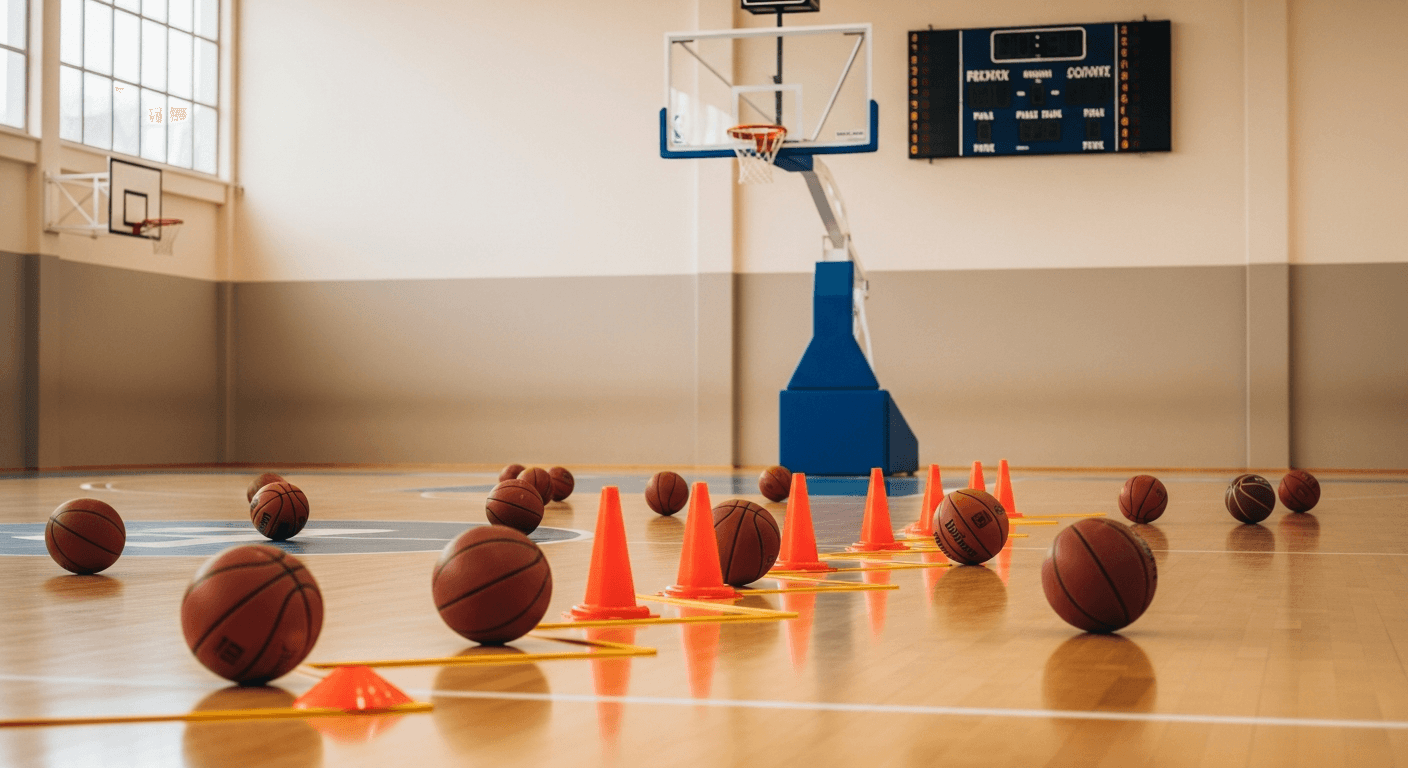
The Big Idea: New Basketball Players Don’t “Lack Fundamentals”—They Lack Basketball Pictures
When a player is new to basketball, most of what looks like “bad fundamentals” is really a missing library of basketball pictures: the mental snapshots of spacing, timing, angles, and pressure that experienced players carry around without thinking. New players don’t see the game early, so they move late. They don’t feel contact coming, so they flinch. They don’t know what “open” looks like at game speed, so they hesitate.
Mid-season, with a HS roster of 12–15, your job isn’t to rebuild everyone from scratch. Your job is to install the pictures that matter most: the ones that stop turnovers, create decent shots, and keep you from bleeding points in transition. The fastest way to do that is not more lectures. It’s constraints, repetition under light pressure, and clear roles.
Coaching law: If a kid can’t do it at 70% speed with a decision, they won’t do it at 100% speed with a defender.
Why These Problems Happen (And Why Yelling Usually Makes Them Worse)
New players are dealing with three simultaneous loads: the ball (technical), the defender (pressure), and the team (decisions). Veterans chunk those into one feeling—“play.” New players experience them as separate emergencies.
That’s why you see the classic symptoms: they dribble too high, pick up the ball too early, stare at the ball, throw floaty passes, stand too close to teammates, and lose their man off-ball. It’s not laziness. It’s attention and anxiety.
In mid-season, anxiety gets extra spicy because the rotation is forming. New players can feel the minutes slipping away. They start playing “not to mess up,” which creates the exact mistakes they fear: tentative cuts, late help, and rushed layups.
Coaching law: Fear makes players shrink their decisions… and expand their mistakes.
The 10 Common Fixes You’ll Make Over and Over (What’s Happening, and What to Do)
Below are the issues that show up most with new HS players—and the specific coaching response that actually changes behavior.
- They dribble high and get stripped. Why: they’ve only dribbled in open space and don’t understand “ball-security distance.” Fix: teach “pocket dribble” and use constraints (one-hand pressure, narrow lanes) so they feel the steal.
- They pick up the dribble with no plan. Why: panic when a defender gets close; they don’t have an exit map. Fix: teach “escape dribbles” (retreat, spin-out, inside-out) and give them a rule: no dead dribble in the middle.
- They pass soft or floaty. Why: they’re aiming like a game of catch, not throwing through a defender’s hands. Fix: teach step-to-pass, target windows, and require “chest-to-chest” velocity on short passes.
- They travel on catches and pivots. Why: they don’t know what foot is the pivot foot under speed and contact. Fix: teach “jump stop = options,” and rep catches into jump stop with a defender bump.
- They crowd the ball (bad spacing). Why: they chase the action like soccer or playground ball. Fix: give them spacing rules (corners filled, 15–18 feet apart, “one in, one out”) and punish spacing errors with automatic turnovers in practice games.
- They don’t cut with purpose. Why: they don’t know when they’re being guarded or denied; they cut because coach yelled “move!” Fix: teach two reads: defender’s head turned (backcut) and overplay (v-cut). Make cuts score-or-screen—no jogging.
- They lose their man off-ball on defense. Why: they watch the ball like a movie. Fix: teach “ball-you-man” positioning and use shell with scoring consequences for lost vision.
- They help too much or not at all. Why: they don’t understand “help line” and timing. Fix: define roles: on-ball contains, one pass away denies, two passes away in gap. Use drive-and-kick games with help rules.
- They can’t finish layups under contact. Why: they’ve never practiced finishing while being hit, and they decelerate into the shot. Fix: teach “inside shoulder, outside hand” and “finish through the square,” add pad contact and a time/score constraint.
- They don’t sprint back in transition. Why: they admire shots, complain, or don’t know their assignment. Fix: give a simple transition identity: 3 back, 2 crash (or your system). Grade it publicly.
Coaching law: The fix is rarely “try harder.” The fix is “make the right thing easier to choose.”
Shoutable Coaching Cues (Keep Them Short, Keep Them Honest)
These are the phrases you can repeat until they become your team’s shared language. Use them during drills and games so the brain doesn’t have to translate.
- “Chin it. See it.”
- “Pound it—pocket!”
- “No dead dribble!”
- “Jump stop—options!”
- “Pass on a step!”
- “Corners filled—breathe!”
- “Cut to score!”
- “Ball-you-man!”
- “Gap! Early help!”
- “Hit first—rebound!”
- “Sprint back—talk!”
- “Next play—now!”
Four to Six Drills That Fix “New Player Problems” Without Turning Practice Into a Clinic
These are designed for a HS team in mid-season: efficient, competitive, and realistic. Each drill builds the pictures new players need—under just enough pressure to matter.
Drill 1: Narrow-Lane Pressure Dribble (Pocket & Escape)
Setup: Use the sideline as one boundary and place cones to create a 6–8 foot-wide lane from baseline to half court. Players go in pairs: ballhandler and a trailing/side defender with a hand checking space (no reaching across the body early; progress to live).
How it works: Ballhandler must advance to half court without losing the ball. Defender applies controlled pressure. On coach clap, ballhandler must execute an escape (retreat dribble or spin-out) then re-advance.
Coaching points:
- Low hips, wide base; dribble at the “pocket” (outside knee).
- Teach “body between ball and defender.”
- Eyes up: name a teammate’s number or call out a color on the wall to force vision.
- Progression: add a second defender at half court to simulate a soft trap—now they must escape and pass.
Coaching law: If you want ball security, you must practice with someone trying to take it.
Drill 2: Pivot & Pass Under Heat (Jump Stop Series)
Setup: Three lines on the perimeter (top, wing, corner). One passer, one receiver, one defender with a pad (or forearm contact). Balls at the top.
How it works: Receiver sprints to a spot, catches, and must land in a jump stop. Defender gives a legal bump with pad/forearm on the catch. Receiver must pivot (front or reverse) and make a crisp pass to the next spot. Rotate.
Coaching points:
- “Jump stop—options”: land balanced, knees bent.
- “Chin it. See it.”: ball to chin, eyes scan.
- Pivot with purpose: don’t spin for fun—pivot to create a passing window.
- Pass on a step: step toward target, snap wrists, show hands.
Drill 3: Spacing Tag (Corners, Slots, and the ‘No Clumping’ Rule)
Setup: 5 offensive players vs 0 defense to start, then add 2 defenders. Mark five spots: two corners, two slots, one top. Use tape or cones if needed.
How it works: Offense passes and cuts on coach signal. The constraint: no two offensive players can be within 8 feet. If they clump, it’s an immediate turnover (defense gets a point once defenders are added). Add two defenders who can “tag” cutters lightly to create realistic timing.
Coaching points:
- Teach the picture: corners are “gravity.” Slots are “decision points.”
- After you pass: either cut with a reason or space to a spot—no standing in the same air.
- Use language: “Fill behind,” “Replace,” “Drift corner.”
Coaching law: Spacing isn’t a concept; it’s a habit enforced by rules.
Drill 4: Two-Read Cutting Game (V-Cut or Backcut)
Setup: 3v3 on one side of the court (wing, corner, top). One coach or manager as passer at the top if needed. Defense plays live but no steals on the first rep (then live).
How it works: Off-ball players must make one of two cuts based on the defender:
- If defender is on the line, up the line (denying), cutter backcuts.
- If defender is below the line (sagging), cutter v-cuts to get open.
Score only counts if the basket comes directly from a correct read (catch-and-score, or catch leading to an immediate advantage).
Coaching points:
- “Cut to score!”: sprint the first three steps.
- Show hands early on the backcut; finish away from shot blocker.
- On v-cut: sell the cut with eyes and shoulders; plant hard; come back to the ball.
Drill 5: Drive-and-Kick Advantage (Help Timing & Simple Rotations)
Setup: 4v4 in the half court. Place one offensive player in each corner and slot; one at top. Defense matches up. Start with a pass to the wing.
How it works: On the catch, offense must drive within two seconds. Defense must follow your help rules: two passes away is in the gap; one pass away is “stunt and recover” (or your system). Offense scores by creating a paint touch that leads to a shot: layup, kick three, or drop-off.
Coaching points:
- Teach defenders the picture: “Ball-you-man” plus “gap” positioning.
- Offense: drive with a plan—finish, dump, or spray.
- Passes must be on time: “catch-ready-shoot” or “catch-drive.” No statues.
Drill 6: Transition Identity Scrimmage (3 Back, 2 Crash)
Setup: 5v5 full court. Decide your rule: for example, 3 players must sprint back on shot, 2 may crash. Or assign: point guard always back, opposite wing always back, etc.
How it works: Any time a team violates the transition rule (watching the shot, complaining, jogging), the other team gets an automatic point plus the ball. Keep it fast: play to 11.
Coaching points:
- Define “back” as paint touch on defense (get to the lane line first).
- Talk early: matchups in transition are temporary—pick up ball, protect rim, then sort.
- Reward the habit: call out the best sprinter, not just the scorer.
Coaching law: Transition defense is a culture test: it reveals who’s with you when they’re tired.
What Coaches Commonly Get Wrong (And the Fix)
These are the traps that make new players stay new.
- Mistake: Correcting everything at once. Why it fails: they freeze. Fix: pick one “non-negotiable” per week (ex: no dead dribble) and grade it.
- Mistake: Over-teaching in long lines. Why it fails: no reps, no pressure. Fix: use small-sided games (3v3, 4v4) with constraints.
- Mistake: Calling them “unathletic” when they’re actually unsure. Fix: give them a map: where to stand, when to cut, what the first read is.
- Mistake: Only praising makes. Fix: praise correct decisions and effort plays (early help, sprint back, jump stop under bump).
- Mistake: Teaching defense as “want to.” Fix: teach defense as angles and jobs: contain, gap, tag, box out.
- Mistake: Letting veterans freeload on spacing while newbies get blamed. Fix: make spacing a team rule with team consequences.
- Mistake: Assuming they know what “open” means. Fix: define it: “two steps of separation” or “catch with shoulders square.”
- Mistake: Punishing turnovers without teaching causes. Fix: label turnover types (dead dribble, soft pass, bad angle) and coach the specific opposite behavior.
- Mistake: Subbing them out only when they mess up. Fix: pre-plan minutes and roles; sub to teach, not to shame.
- Mistake: Giving feedback during the rep. Fix: let the rep finish, then give one sentence, then run it again immediately.
Coaching law: The standard is the standard—but the teaching has to match the learner.
The Player Archetypes You’ll See (And How to Coach Each One)
New-to-basketball players aren’t all the same. If you coach them like they are, you’ll misread effort and miss the real lever.
- The Athlete-Newbie: fast, jumps high, plays chaotic. Coach them with constraints: narrow lanes, two-dribble limits, “must jump stop.” They need brakes and pictures, not hype.
- The Thinker: wants to do it right, hesitates, passes up shots. Coach with permission: “If you’re open, you shoot.” Give them two reads only. Celebrate decisiveness.
- The Tough Kid: will defend and rebound, but avoids the ball. Coach with role pride: “You’re our stopper,” plus one simple offensive job (screen-and-dive, corner spacer). Let confidence grow from usefulness.
- The Skill-From-Another-Sport: can catch/throw but travels, double dribbles, stands wrong. Coach with translation: compare to their sport (angles like soccer, spacing like football routes), but insist on basketball footwork reps.
- The Quiet Drifter: disappears off-ball, loses man, doesn’t talk. Coach with explicit communication tasks: they must call “ball,” “help,” “cutter,” or they sit for a possession. Not punishment—accountability.
Coaching law: Confidence comes from clarity, not compliments.
A Couple “Coach Moments” That Changed How I Teach New Players
The first was a sophomore who kept picking up his dribble at the first sign of pressure. I rode him for it—“Don’t pick it up! Be strong!”—and he got worse. After a game, he told me, quietly, “Coach, I pick it up because I don’t know where to go.” That’s the whole story right there: he didn’t need motivation. He needed an exit plan.
We built one: if trapped on the sideline, retreat dribble to create space; if cut off, spin back to the middle; if help comes, pass to the release. Within two weeks, the same kid looked “tougher,” but what really happened is he stopped feeling lost.
The second was a new player who kept losing her man on weakside defense. I kept saying “See both!” and she kept nodding—then immediately stared at the ball again. The fix was embarrassingly simple: in shell, I made her point with her top hand to the ball and bottom hand to her player. Suddenly her body organized itself into the right spot. She didn’t need more words. She needed a physical cue that built the picture.
Coaching law: When a player repeats a mistake, assume your instruction is unclear—not their character.
Practice Design in Mid-Season: How to Teach Without Derailing the Team
You’re not in preseason. You can’t spend 40 minutes on stationary dribbling. But you also can’t pretend new players will “figure it out” in scrimmage. The middle path is embedded development: keep your team concepts, but build constraints that force the right habits.
- Use progressions: 0 defense to guided defense to live. New players need early wins before chaos.
- Group smart: pair a new player with a steady veteran in small-sided games. Avoid stacking all new players together unless the drill is very structured.
- Compete with purpose: score the behaviors you want (paint touches, jump stops, sprint-back compliance), not just buckets.
- Feedback timing: use “freeze” sparingly. Prefer quick huddles: one sentence, then replay the rep.
- Constraints beat speeches: two-dribble max, must touch paint before a three, turnovers for spacing violations—these teach faster than reminders.
Coaching law: You don’t rise to your motivational speech; you sink to your practice rules.
Psychology and Team Dynamics: Getting Buy-In Without Separating “Hoopers” and “Newbies”
New players often feel like guests in a culture that existed before them. Veterans can unintentionally reinforce that by rolling eyes at mistakes or refusing to pass to the “turnover risk.” If that becomes the vibe, your new players will stop being aggressive, and your veterans will stop learning patience and leadership—two things you need in February.
Make improvement a team identity: “We’re a program that develops.” Then prove it with your actions.
- Normalize mistakes as data: label the mistake type, teach the fix, move on. No sarcasm.
- Protect confidence publicly: correct privately when possible; praise effort and correct decisions loudly.
- Create trust reps: in drills, require veterans to pass to new players on advantage. It teaches the whole team that the system is bigger than comfort.
- Give new players ownership: assign them a role that matters (rebounding, sprint-back captain, best-cutter award). Identity drives effort.
Coaching law: The team becomes what gets respected, not what gets said.
Game-Day Application: Roles, Substitutions, and Simple Adjustments That Help New Players Succeed
On game day, your new players don’t need freedom; they need clarity. Give them a small job list that fits their current pictures.
- Define their offensive role: corner spacer + baseline cutter; or screener + rim runner; or “catch and drive right.” Keep it tight.
- Define their defensive role: “Guard the worst shooter and be our best talker,” or “Box out every shot.”
- Sub with a plan: don’t wait for a mistake. Sub at natural breaks and tell them what success looks like in the next 2 minutes.
- Use short leashes wisely: if you must pull them, do it with information: “You’re safe. Next time: jump stop, chin, pass.” Then get them back in later so they don’t attach identity to failure.
- Adjust the environment: if pressure is killing them, start them with a veteran ballhandler. If they crowd spacing, put them in the corner where the rule is simple: stay spaced, be ready, cut baseline on dribble-at.
And communicate in-game with the same cues you used all week. New players don’t have time for paragraphs during a timeout.
Coaching law: Players can’t execute what they can’t describe in one sentence.
Closing: Build the Pictures, Then Demand the Habits
Fixing new-to-basketball problems is less about perfect form and more about creating the right pictures—then rehearsing those pictures under pressure until they become habits. Your mid-season advantage is that games are giving you real feedback: where do they panic, where do they clump, where do they stare, where do they stop running?
Use that feedback to choose the next constraint, the next cue, the next small-sided game. And remember: the goal isn’t to turn every new player into a point guard. It’s to make them playable—trusted—so the team gets deeper and tougher when the season tightens up.
Coaching law: Development isn’t extra. Development is how you survive the season.
Tags
Related Articles
Take Your Coaching to the Next Level
Practice Plan helps coaches create, organize, and share professional practice plans — all in one place, built for coaches.
Free to start • Available on iOS & Web
For Leagues & Associations
Give your coaches a free tool — at no cost to you.
Partner with Practice Plan and your coaches get a 14-day free trial. You just forward one email. No budget, no contracts.
Get Coaching Articles in Your Inbox
Subscribe to receive new articles. Choose your sports to get personalized content.
No spam, unsubscribe anytime.