
The Parent Skill-Builder: Why the Best Youth Coaches Recruit a Second Coaching Staff at Home
The biggest hidden variable in youth sports isn’t the playbook, the facility, or even the coach’s experience. It’s what happens between practices—on the driveway, in the hallway, at the park, in the five minutes before dinner. Parents are the most underused “assistant coaches” in elementary and YMCA-level sports, and the teams that understand this develop faster, complain less, and stay in sports longer.
Here’s the thesis: Parents don’t need to teach the sport. They need to teach the athlete. When parents help kids build basic athletic skills—balance, coordination, catching/throwing mechanics, stopping and starting, spatial awareness, and emotional control—coaches get to coach the game instead of constantly patching holes in movement. That’s not a small difference. It changes practice design, confidence, and how fast a group can learn.
Coaching Law: The sport is the classroom; athleticism is the language. If kids don’t speak the language, every lesson takes twice as long.
What “Parents Teaching Skills” Really Means (and What It Doesn’t)
Let’s clear the air. When coaches hear “parents should teach skills,” some picture a parent trying to rewire a jump shot, micromanage a batting stance, or yell instructions from the sideline like a second head coach. That’s not the goal. The goal is simpler and more powerful: parents create repetitions and resilience in low-stakes environments.
At the YMCA/elementary level, kids are learning how their bodies work. They’re learning how to try, miss, and try again without taking it personally. Parents can provide the volume and emotional safety that practices can’t always provide—especially when you’ve got 12–15 kids and limited time.
Coaching Law: Skills grow in reps; confidence grows in safe reps.
Here’s the division of labor that works across sports:
- Coaches: teach the game, create competitive constraints, guide decision-making, and build team standards.
- Parents: build the athletic base, reinforce simple cues, and protect the child’s relationship with effort.
When that partnership is healthy, the kid’s progress feels inevitable. When it’s not, the kid becomes a tug-of-war rope: coach pulls one way, parent pulls another, and the athlete gets frayed in the middle.
The Athletic “ABC’s” Parents Can Build (and Why Coaches Should Care)
Most “beginner sport problems” aren’t sport problems. They’re movement problems wearing a jersey. The kid who can’t “stay in front” on defense often can’t decelerate. The kid who “doesn’t hustle” often doesn’t know how to run efficiently or is embarrassed by how they look. The kid who “panics with the ball” often can’t track a moving object while moving themselves.
Parents can help with the athletic ABC’s:
- A = Agility: start/stop, change direction, body control
- B = Balance: single-leg stability, landing, posture
- C = Coordination: hands/feet timing, rhythm, catching/throwing patterns
These aren’t glamorous, but they’re the foundation of everything. And they’re easiest to build when the kid is young and the environment is playful.
Coaching Law: Most “effort issues” are actually “ability-to-move” issues.
A Coach Moment: The “Uncoachable” Kid Who Just Needed a Garage
I once had a middle school athlete—smart, funny, and constantly “not listening.” At least that’s what it looked like. In practice, he’d drift. He’d forget instructions. He’d avoid the ball. The staff labeled it focus, attitude, motivation.
Then I saw him in a different setting: a casual family event where his dad brought a soft ball and started tossing it in the driveway. The kid lit up. The reps were simple, the feedback was calm, and the pace was his. Within ten minutes he was tracking better, moving his feet, and asking for “one more.”
The next week, the dad told me they’d started doing five-minute “driveway catch” most nights. In a month, the kid wasn’t just better—he was braver. He started calling for the ball. The “focus problem” was partly anxiety: he didn’t trust his body to do what the game demanded. The garage fixed what my whistle couldn’t.
Coaching Law: Confidence is a motor skill too.
How to Talk to Parents Without Starting a War
Parents want to help. They just don’t always know what “help” looks like. Many default to what they can see: game outcomes, stats, playing time, or “fixing” technique with complicated instructions. Your job is to give them a simpler target.
Try this message early and repeat it midseason: “At home, we’re not coaching the sport. We’re building the athlete.”
Then give them a “minimum effective dose” plan: 10 minutes, 3 times per week. Make it feel doable, not like homework. Parents are busy; they need a plan that respects reality.
Coaching Law: If the plan is too big, it becomes guilt—not growth.
4–6 Sport-Integrated Drills Coaches Can Use (That Parents Can Mirror at Home)
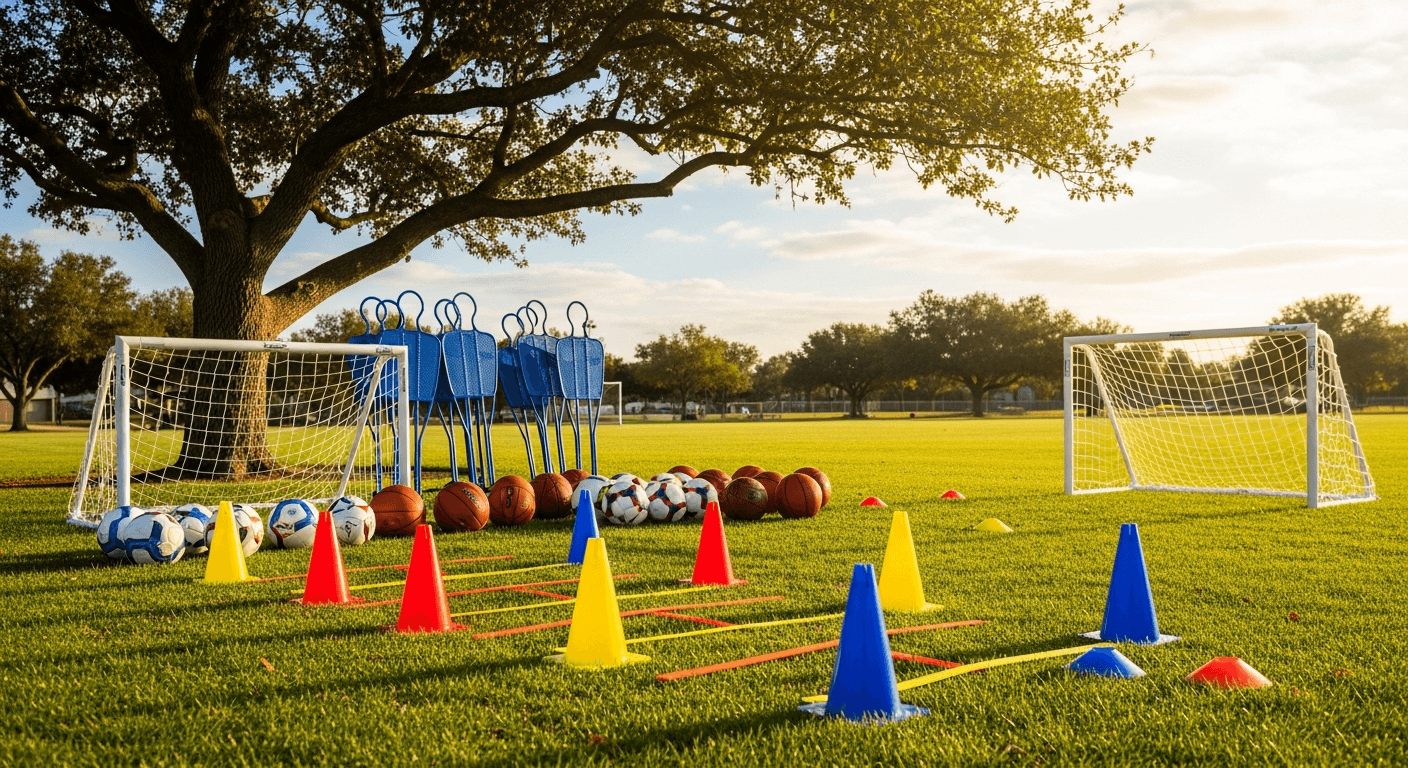
These drills work in a practice facility with 12–15 athletes and translate across sports. The secret is that each one teaches an athletic skill through a sport-like task. They also give parents a clear “copy-and-paste” version they can do at home with minimal equipment.
Drill 1: “Stoplight Starts” (Acceleration + Deceleration Under Control)
Setup: Create a 15–20 yard lane (or court-length segment). Use three cones: start, middle, finish. Athletes spread out with space.
How it works: On your call, athletes move in an athletic stance. “Green” = go (accelerate). “Yellow” = slow (chop steps, control). “Red” = stop and hold balance for two seconds. Progress from straight-line to slight angles or curves.
Coaching points:
- Teach “brakes”: hips back, chest proud, quiet feet.
- Stop under control—no falling, no extra steps.
- Eyes up (not staring at feet).
Drill 2: “Wall Toss Ladder” (Tracking + Catching + Rhythm)
Setup: One ball per athlete (or per pair), a wall, and tape marks or targets at different heights. Use any ball: foam, soccer ball, basketball, tennis ball.
How it works: Athletes throw to the wall and catch on the rebound. Ladder progression: two-hand catch, right-hand only, left-hand only, clap-catch (clap once before catching), turn-and-catch (start sideways, rotate to catch). Keep score: 30 seconds, how many clean catches?
Coaching points:
- Hands “show a target” early.
- Soft hands—absorb, don’t slap.
- Track with eyes first, then hands.
Drill 3: “Mirror Tag in a Box” (Footwork + Body Control + Competitive Fun)
Setup: Make a 10x10 or 12x12 box with cones. Pair athletes. One is leader, one is mirror.
How it works: Leader moves laterally, forward/back, and changes speed. Mirror stays in front. After 15–20 seconds, switch. Progress to “tag”: leader tries to tag mirror’s knee; mirror avoids while staying in the box.
Coaching points:
- Stay low: knees bent, hips loaded.
- Small steps first, then speed.
- Win with angles, not reaching.
Drill 4: “Three-Object Scan & Go” (Awareness + Decision-Making + Movement)
Setup: Place three cones (or colored spots) in a triangle 8–12 yards apart. Athletes start in the middle. Coach stands where athletes can see you.
How it works: Call a color/number or hold up fingers to signal which cone to sprint to. Add a ball carry/dribble for sport transfer (basketball dribble, soccer dribble, hockey stickhandle, football tuck). Add a “fake call” where you change the signal mid-move to teach reactivity.
Coaching points:
- Head up—scan before you go.
- Plant outside foot to change direction.
- Control first, then speed.
Drill 5: “Partner Lead Pass” (Timing + Moving to Space)
Setup: Pairs with one ball. Create a lane 10–15 yards long. One athlete is mover, one is passer/roller/tosser depending on sport.
How it works: The mover jogs, then accelerates; the partner leads them with a pass/toss/roll into space. The mover catches/collects on the move and returns it. Switch roles. Add a defender cone they must run around to simulate game movement.
Coaching points:
- Move first—don’t stand and wait.
- Lead the run, not the body.
- Catch/collect with momentum.
Coaching Cues You Can Shout (and Parents Can Repeat)
Good cues are short enough to survive pressure. Use these across sports and keep them consistent so parents don’t accidentally introduce a competing language.
- “Eyes up, chest proud!”
- “Quiet feet, loud hips!”
- “Brake under control!”
- “Show your hands early!”
- “Beat them with angles!”
- “Catch it soft!”
- “Small steps, then go!”
- “Find space, then play!”
- “Next play, quick reset!”
- “Win the first step!”
Common Mistakes Coaches Make About Parents (and the Fix)
Parents can be the jet fuel or the sandbag. Often it depends on whether the coach gives them a role that helps instead of a vacuum they fill with anxiety.
- Mistake: Treating parents as obstacles. Fix: Treat them as partners with a clear job: “athlete-building reps at home.”
- Mistake: Giving parents technique lectures. Fix: Give them simple games and two cues max.
- Mistake: Only contacting parents when there’s a problem. Fix: Send one positive “here’s what we’re working on” message midseason.
- Mistake: Letting sideline coaching slide. Fix: Set a standard: “Cheer effort, not instructions.” Repeat it.
- Mistake: Assuming kids practice at home. Fix: Build “homework reps” into practice: “Here’s the 5-minute version.”
- Mistake: Confusing intensity with development. Fix: Ask for consistency: 10 minutes, 3 days/week beats one 60-minute battle.
- Mistake: Shaming parents who don’t know sports. Fix: Offer non-sport options: balance games, wall toss, stoplight starts.
- Mistake: Over-indexing on winning at YMCA ages. Fix: Measure progress in movement quality and bravery with the ball.
- Mistake: Using different language than parents. Fix: Share your cues so the athlete hears one message.
- Mistake: Ignoring sibling/peer dynamics at home. Fix: Encourage “family challenges” where everyone participates and laughs.
Coaching Law: The kid can’t serve two masters—align the message.
Psychology: Why Parents Matter Even More Than Reps
Reps matter, but the emotional environment around reps matters more. For beginners, the biggest performance limiter is often not strength or speed—it’s threat. The ball feels like a threat. Missing feels like a threat. Looking awkward feels like a threat. When kids feel threatened, they get stiff, they hide, and they stop trying new things.
Parents can lower threat in ways coaches can’t, because home is where identity forms. A parent who celebrates effort (“I love how you kept trying”) builds a kid who can survive mistakes in front of teammates. A parent who interrogates outcomes (“Why didn’t you score?”) builds a kid who plays not to fail.
In team dynamics, this shows up as:
- Attention: Kids with high anxiety look “distracted.” They’re scanning for danger, not listening for coaching.
- Ego: Kids who fear embarrassment become “too cool” to try.
- Buy-in: Kids buy into what their parents respect. If parents mock practice, kids treat it like a joke.
- Trust: Players trust coaches more when parents speak respectfully about them at home.
Coaching Law: The fastest way to improve skills is to reduce fear.
Player Archetypes You’ll See (and How Parent Support Changes the Plan)
In a group of 12–15, you’ll see patterns. These archetypes show up across sports, and parents can either soften the rough edges or sharpen them.
- The Fearful Beginner: Avoids the ball, hangs back. Coach move: give protected reps (smaller ball, shorter distance, partner support). Parent role: playful reps at home with soft equipment and praise for trying.
- The Backyard Star: Looks great alone, struggles in chaos. Coach move: small-sided games with decision-making. Parent role: add constraints at home (move then catch, weak hand, time limits).
- The Over-Coached Kid: Paralyzed by instructions, asks “Was that right?” Coach move: limit feedback, ask questions, reward creativity. Parent role: stop mid-rep correcting; use one cue and let it go.
- The Late Bloomer: Trying hard, body isn’t cooperating yet. Coach move: celebrate micro-wins, give roles that matter (hustle tasks, spacing). Parent role: consistency and patience—no comparisons.
- The Emotional Spark: Big feelings, quick frustration. Coach move: reset routines (“breath, word, next rep”). Parent role: model calm after mistakes; avoid post-game interrogations.
Coaching Law: Same drill, different kid, different dose.
Practice Design: Build Skills in a Way Parents Can Reinforce
Midseason is where teams either plateau or leap. The leap usually comes from better practice design: fewer lines, more touches, more decisions, and feedback that doesn’t smother.
Design your practices so the “home version” is obvious. If you run Mirror Tag, tell kids: “You can do this with a sibling in the living room—just clear space.” If you run Wall Toss Ladder, tell them: “Thirty seconds a day.”
Practice strategies that translate across sports:
- Constraints: Change rules to teach movement (weak-hand only, must change direction before passing, two-touch limit).
- Progression: Start simple (no defender), then add time pressure, then add a decision.
- Feedback timing: Coach the rep, then let 3–5 reps happen before the next correction.
- Grouping: Pair kids by confidence, not just ability—brave with fearful, calm with emotional.
- Competition: Keep score in short rounds. Kids focus better when the game is real.
Coaching Law: The goal isn’t perfect reps. It’s repeatable reps.
Game-Day Application: How Parents Can Help Without Hijacking
Game day is where parent influence is loudest. The sideline can either be a safety net or a stress test. Your job is to pre-decide what “helpful” looks like and communicate it clearly.
Helpful parent behaviors that improve performance across sports:
- Cheer effort and courage: “Great try,” “Love the hustle,” “Way to go again.”
- Use your cues, not their own: One consistent language reduces confusion.
- Normalize mistakes: Kids play freer when errors aren’t treated like emergencies.
On your side as coach, tighten game-day roles so parents don’t feel the need to fill gaps:
- Communication: One voice for tactics (you), many voices for encouragement (parents).
- Substitutions: Explain the rotation philosophy early: development minutes, role minutes, and “earning” minutes.
- Adjustments: Keep them simple—one focus per quarter/period/inning. Kids can’t carry five corrections.
Coaching Law: The sideline should raise courage, not cortisol.
A Second Coach Moment: The Parent Who “Helped” Too Much
A few seasons back, I had an athlete whose parent was incredibly engaged. Every car ride included film-level breakdown. Every practice ended with extra instruction. The kid improved… for a while. Then the athlete started playing tight, looking to the sideline after every mistake. The body language screamed, “Tell me what to do.”
We met and reframed the parent’s role: three nights a week, ten minutes, and the parent could only say two things: one cue and one compliment. No corrections after games. The result wasn’t instant perfection—it was something better: the athlete started owning decisions again. The game became theirs, not their parent’s.
Coaching Law: Ownership beats obedience.
Give Parents a Simple Home Plan (That Actually Gets Done)
If you want parents to build athletic skills, give them a plan that fits real life. Here’s a simple template you can share midseason:
- Frequency: 3 days/week
- Time: 8–12 minutes
- Structure: 3 minutes movement (Stoplight Starts), 3 minutes hands (Wall Toss Ladder), 3 minutes game (Mirror Tag or Lead Pass)
- Rule: End on a win (a rep the child feels good about)
Tell parents the truth: the goal is not to create a prodigy. The goal is to create a kid who can join practice without fear and get better every week.
Punchy Coaching Laws to Keep on Your Clipboard
- “Reps don’t count if the kid is scared.”
- “Parents build the athlete; coaches build the team.”
- “One language, one message.”
- “Consistency beats intensity.”
- “Praise effort, coach decisions.”
- “Make home practice playful.”
- “If they can’t stop, they can’t play fast.”
Closing: The Best Youth Program Is a Triangle
The healthiest youth sports environment is a triangle: coach, parent, child. The coach provides structure and competitive learning. The parent provides reps, safety, and identity support. The child provides curiosity and effort. When one corner tries to become the others, the triangle collapses—parents become coaches, coaches become referees of family dynamics, kids become performers instead of learners.
If you’re coaching midseason and you feel like you’re stuck reteaching basic movement every day, don’t just grind harder. Recruit help. Not with more assistants on the bench—with parents at home doing the simple, powerful work: building the athlete.
Because at the YMCA and elementary level, the win isn’t the scoreboard. The win is a kid who can run, stop, catch, throw, and try again—who walks into the next season thinking, “I belong here.”
Tags
Related Articles
Take Your Coaching to the Next Level
Practice Plan helps coaches create, organize, and share professional practice plans — all in one place, built for coaches.
Free to start • Available on iOS & Web
For Leagues & Associations
Give your coaches a free tool — at no cost to you.
Partner with Practice Plan and your coaches get a 14-day free trial. You just forward one email. No budget, no contracts.
Get Coaching Articles in Your Inbox
Subscribe to receive new articles. Choose your sports to get personalized content.
No spam, unsubscribe anytime.