
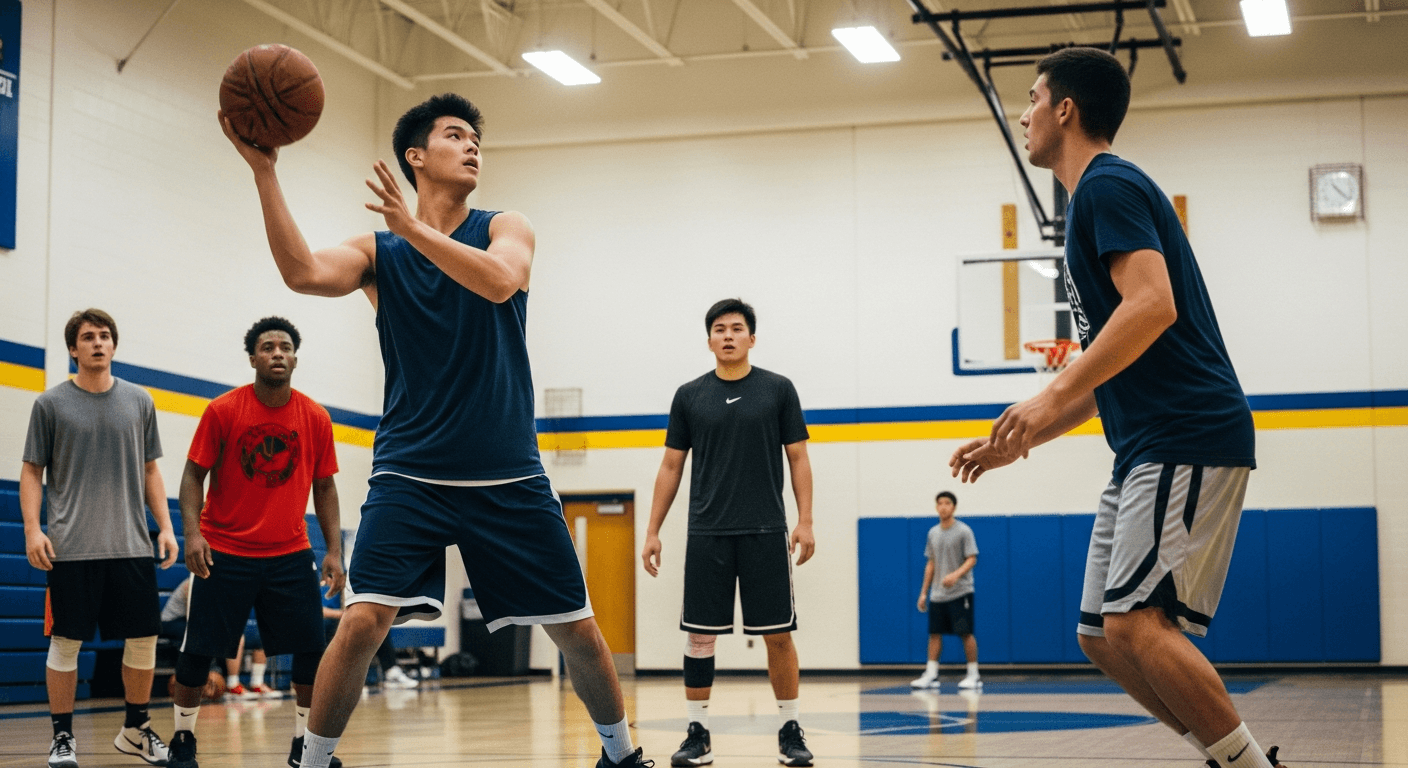
Passing Is Not Being Nice. It’s Being Dangerous.
The best passing teams don’t pass because they’re unselfish. They pass because it’s the fastest way to create an advantage and the most reliable way to keep it. That’s the big idea: passing is an attacking skill, not a character trait.
When coaches talk about passing like it’s a moral issue (“share it,” “don’t be selfish”), players hear a lecture. When you talk about passing like it’s a weapon (“move the defense,” “create two-on-one,” “make the help pay”), players hear a plan. And plans get buy-in.
In mid-season, you’re usually not installing a brand-new offense. You’re sharpening decisions. Passing is the quickest way to improve decision-making because it forces players to see the floor, manage tempo, and connect teammates into one unit instead of five separate auditions.
Coaching Law #1: The ball moves faster than the feet, but only if the mind moves faster than the ball.
Why Players Don’t Pass: The Real Reasons
Most players don’t “refuse” to pass. They fail to pass because of predictable human stuff: fear, ego, attention, and identity. If you want more passing, you’re coaching psychology as much as technique.
They Don’t See It (Attention and Vision)
Young players have “ball-vision.” Their attention collapses onto the dribble, the defender in front, and the rim. Even at high school, under pressure, attention narrows. Players miss the corner shooter because their brain is busy surviving the trap.
Passing improves when you train what players look at and when they look. “See two defenders” is a better cue than “look up.” “Scan on the catch” beats “don’t dribble your head down.”
They Don’t Trust It (Trust and Reward History)
Players pass when they believe the pass will lead to something good. If they’ve watched teammates miss layups, travel on catches, or freeze and dribble back out, they learn a dark lesson: “My pass wastes my advantage.” That’s not selfishness—it’s experience.
Trust is built when players feel their teammates will do something competent with the ball. That means your passing problem might actually be a catching problem, a finishing problem, or a spacing problem wearing a passing mask.
Coaching Law #2: Players don’t pass to teammates. They pass to outcomes.
They’re Afraid (Anxiety and Turnovers)
Some teams treat turnovers like sins. Players respond by choosing the safest path: hold it, dribble it, shoot it—anything that keeps the mistake “theirs,” not a risky pass that could become a steal and a coach’s glare.
If you want daring passes, you need a clear standard: which turnovers are unacceptable (lazy, late, casual) and which are the cost of playing fast and connected (early-ahead passes, tight-window kickouts, pocket passes vs. aggressive hedges).
They’re Chasing Status (Ego and Identity)
Basketball is a status sport. Points are currency. Assists are “nice,” but points get the attention. If a player’s identity is “scorer,” passing can feel like giving up their role. If your team culture celebrates buckets but barely mentions the pass that created the bucket, you’re teaching players what matters.
Coaching Law #3: You get more of what you praise in film than what you yell about in practice.
They’re Not Sure How (Timing and Angles)
Finally, the simplest reason: they don’t know how. Not “how to chest pass,” but how to pass in real basketball—on time, on angle, with the right pace, to the right hand, away from help, and with a plan for what happens next.
When players hesitate, it’s often because they’re doing math: “Is that open? Will it be open? What if he drops it? What if it gets picked?” Better passing is often just faster clarity.
The Levels of Basketball and Their Passing Tendencies
Passing problems look different depending on the level, because the game’s incentives and stressors change. Here’s what tends to show up at each stage, and what it means for you as a coach.
Youth YMCA: The Ball Is a Magnet
At YMCA level, the game is mostly a chase. Spacing is accidental. Players are learning which basket to attack and what traveling is. Passing is rare because dribbling itself feels like freedom—“I can move the ball myself!”
Common tendencies:
- Dribble-first identity: Players equate dribbling with “playing.”
- Late passing: They pass after they’re stuck, not to avoid getting stuck.
- Throw-and-hope: Passes are launched without target-hand awareness.
- Crowd gravity: Everyone runs to the ball, shrinking passing windows to zero.
Coaching implication: You’re not “teaching ball movement.” You’re teaching recognition: pass to a teammate who is closer to the basket, or pass away from pressure. Keep it simple and celebratory. A completed pass is an event.
Coaching Law #4: At the youngest levels, passing is a vision skill before it’s a skill skill.
Youth Select: The Best Player Gets Stuck
Youth Select introduces a new problem: talent gaps. One or two players can score at will, so the team learns a habit: “Give it to our best kid.” That kid learns a habit too: “I am the offense.”
Common tendencies:
- Hero-ball with structure: It looks like offense until the defense loads up.
- Teammates spectate: Off-ball players stop cutting because they don’t expect the ball.
- Passing becomes permission-based: Players only pass if the coach calls a set.
- Risk-avoidance: Players fear making the “wrong” play and getting benched.
Coaching implication: You’re teaching the best player that passing is not surrender—it’s leverage. If the defense sends two, the pass is the shot. If the defense stays home, the drive is the shot. Make “draw two, pass one” a team identity.
Coaching Law #5: The best scorer on your team should also be your best passer—or your ceiling stays low.
Middle School: The Game Speeds Up, the Mind Doesn’t
Middle school is where pressure defense and pace expose decision-making. Players can dribble enough to get themselves into trouble, and defenses are aggressive enough to punish slow reads. This is the golden age of the “almost pass”—they see it, but a beat late.
Common tendencies:
- Jump-stop panic: Players pick up the ball and spin, searching.
- One-read passing: They only see the first option; if it’s not there, they freeze.
- Telegraphed kickouts: The eyes give it away; defenders sit in the gap.
- Bad spacing habits: Players drift toward the ball, shrinking the floor.
Coaching implication: You’re teaching early decisions. “Catch and see” becomes “catch already knowing.” Teach players to scan before the catch, and to recognize common pictures: help from the nail, tag from the low man, stunt-and-recover, and the difference between a hard closeout and a soft closeout.
High School: The Defense Is Scheming, and Roles Are Real
In high school, defenses have scouting reports, help rules, and personnel decisions. Passing becomes less about “sharing” and more about “solving.” Players also have more ego invested: varsity minutes, rankings, social media clips, and the quiet pressure to be “that guy.”
Common tendencies:
- Predetermined drives: Players decide to score before they read help.
- Skip-pass fear: Players avoid long passes because of turnovers and coach reactions.
- Overpassing by role players: Some players pass up open shots to avoid responsibility.
- Ball-stopping: Catch, hold, jab, survey—defense resets.
Coaching implication: You’re teaching advantage basketball: create an edge, then keep it moving until it becomes a layup, a free throw, or a clean three. Passing is the language of advantage. Your team needs shared definitions: What is an advantage? What do we do when we have one? What pass is required against a stunt? Against a switch? Against a hard hedge?
Coaching Law #6: The goal isn’t “one more pass.” The goal is the pass that makes the defense wrong.
What Passing Really Is at High School Speed
At varsity level, “good passers” aren’t just accurate. They are early, deceptive, and purposeful. They pass to space, to a hand, to a footwork pattern, to a timing window. They understand that every pass is also a message to the defense.
Passing Is a Timing Decision, Not a Movement
Most turnovers aren’t from bad mechanics. They’re from late timing. The window was open, then it wasn’t. High school defenses rotate on the flight of the ball. If you pass after the help has arrived, you’re not “moving it”—you’re donating it.
Teach players to pass on the first moment the defense commits:
- On the first step of a closeout (attack the gap, or hit the next).
- On the first slide of help (dump-off, corner, or slot).
- On the first trap angle (split if possible; otherwise, early outlet).
Passing Is Geometry: Angles and Help Defenders
Players often think the defender guarding the receiver is the main problem. Usually it’s not. It’s the help defender in the lane line gap, the “nail” defender, the low man on the baseline, or the top defender jumping a reversal.
Teach your team to identify the real thief:
- Nail defender: steals pocket passes and late drive-and-kicks.
- Low man: tags the roller and closes to the corner—your pass must beat him early.
- Top-side denial: forces backdoor windows—pass must be on time and low.
Coaching Law #7: Most “bad passes” were actually bad reads of the help, not bad throws.
Passing Is Also a Threat
The best passers are scoring threats. A defender doesn’t react to a passer who never shoots. That’s why some high school teams “move it” and still get nothing—because the defense doesn’t have to collapse.
So when you preach passing, don’t accidentally create passivity. You want players who are two-way dangerous: they can shoot it, drive it, or pass it. Their passing works because their scoring is believable.
How to Sell Passing to Players Without Making It a Lecture
Players don’t buy passing because it’s “right.” They buy it because it works for them. Your job is to connect passing to the things they already want: points, freedom, confidence, and winning.
Sell the Why: Passing Creates Easier Scoring
Show them the math of the game. A contested pull-up is a low-percentage shot. A paint touch that draws help and kicks to a set shooter is a high-percentage shot. A hit-ahead pass before the defense loads is basically a layup with paperwork.
Use film language players understand:
- “That pass turned a tough two into a clean three.”
- “You drew two—your pass is your assist even if it’s hockey.”
- “We didn’t need a better play. We needed the pass one beat earlier.”
Sell the Identity: “We Are a Team That Creates”
Teams pass more when passing is part of who they are, not just what they do. Identity is powerful because it’s social: players protect what the group stands for.
Try identity statements that are specific and competitive:
- “We make the help defender wrong.”
- “We don’t play in crowds.”
- “We punish ball-watching.”
- “We are fast with our decisions.”
Notice none of those say “be unselfish.” They say “be dangerous.”
Sell the Freedom: Good Passing Earns You More Choices
Players fear that passing means giving up shots. Flip it: good passers earn more touches. Teammates trust them. Coaches trust them. The ball finds them because the ball likes people who keep it alive.
This is especially important for your high school role players. Some of them overpass because they’re afraid to shoot. Give them permission: “Your job is to be ready to score. Passing is what you do when the defense takes that away.”
Coaching Law #8: Passing isn’t giving up your shot. It’s choosing a better one—sometimes for you.
Team Dynamics: The Invisible Stuff That Makes Passing Work
Passing is a trust exercise disguised as a skill. The ball is shared risk. When a player passes, they’re saying, “I believe you’ll do something good with this.” When a player receives and fumbles, hesitates, or forces, they’re breaking a small promise.
Trust Is Built Off the Ball
If your team doesn’t pass, look at what happens after a pass. Do teammates cut hard? Do they space correctly? Do they sprint to corners in transition? Or do they jog and watch?
Players pass to movers. They stop passing to statues. If you want more passing, demand off-ball effort as a non-negotiable.
Ego Management: Praise the Connector, Not Just the Scorer
In most gyms, the scorer gets celebrated. If you want a passing culture, you must become a storyteller who highlights the connector: the guard who hits the advance pass, the wing who makes the extra swing, the post who kicks out on the dig.
In film, don’t just clip makes. Clip advantage creation. Clip the pass that forces a rotation. Clip the player who relocates to open the passing lane. You’re teaching the team what basketball “counts.”
Anxiety and Turnover Culture: Define “Good Mistakes”
Mid-season teams often get tight because every game feels like a referendum. Tight teams don’t pass. They protect themselves. You can loosen them by defining acceptable risks.
Examples of “good mistakes” you can live with:
- An early hit-ahead that’s slightly off because we ran the floor.
- A skip pass versus a loaded-up help defense, even if it gets tipped.
- A pocket pass attempt when the roller had inside leverage.
Examples of “bad mistakes” you should coach hard:
- One-hand, casual passes across the top versus pressure.
- Leaving your feet with no plan and “passing in the air.”
- Passing back to the middle of the floor into traffic.
When players know the difference, they play freer and smarter.
How to Teach “How to Pass” Without Turning It Into a Clinic
This article isn’t a drill sheet, but coaches still need teaching language. Here are concepts that make passing clearer at every level, especially for high school players.
Teach Passing as a Chain: Catch → Read → Deliver
Players often treat passing as a separate action. In reality, it’s a chain. The pass quality depends on the catch quality, and the decision depends on what was seen before the ball arrived.
Coaching cues that help:
- “Hands early, feet ready.” Catching is part of passing.
- “Scan before the catch.” Who is at the nail? Where is the low man?
- “0.5 decision.” Shoot, drive, or move it—no holding.
Teach Targets: Hand, Foot, and Shot Pocket
High school defenses are too fast for “somewhere near him.” Teach pass targets:
- To the outside hand on perimeter catches to protect from stunts.
- To the lead foot on cuts so the receiver runs through it.
- To the shot pocket on kickouts so the shooter can rise without extra dip.
When players learn to pass to a target, turnovers drop and shot quality rises without you changing a single play call.
Teach the Three Most Important Passes in High School
If you only clean up three passes mid-season, make them these:
- The advance pass in transition: hit the wing ahead, then fill behind. This prevents the defense from setting its shell.
- The drive-and-kick to the corner: the corner is the hardest closeout. If you can consistently generate corner threes, your offense changes.
- The post kickout versus the dig: when the guard “digs” down, the kickout must be immediate and on the shooter’s inside/outside hand depending on the closeout angle.
These passes show up every game. They decide whether you get layups and rhythm threes or a bunch of tough twos late in the clock.
The Coach’s Job: Create Clarity, Not Just Demand Sharing
“Pass more” is not instruction. It’s a wish. Players pass more when they understand what you’re trying to create and when they feel safe enough to try.
At YMCA level, clarity is simple: pass away from pressure, pass to someone closer to the rim, spread out. At Youth Select, clarity is role-based: our best player draws two, everyone else moves and is ready. At middle school, clarity is timing: early decisions, see help before it arrives. At high school, clarity is advantage: create it, keep it, cash it.
Mid-season, your team doesn’t need a passing sermon. It needs a passing language: what to see, what to value, what risks are allowed, and what “good” looks like on film.
Because when players finally understand passing as an attack—not as politeness—you’ll feel it immediately. The ball won’t just move. The defense will. And once the defense is moving, the game becomes what it’s supposed to be: five connected players forcing the other team to make impossible choices.
Tags
Related Articles
Take Your Coaching to the Next Level
Practice Plan helps coaches create, organize, and share professional practice plans — all in one place, built for coaches.
Free to start • Available on iOS & Web
For Leagues & Associations
Give your coaches a free tool — at no cost to you.
Partner with Practice Plan and your coaches get a 14-day free trial. You just forward one email. No budget, no contracts.
Get Coaching Articles in Your Inbox
Subscribe to receive new articles. Choose your sports to get personalized content.
No spam, unsubscribe anytime.