
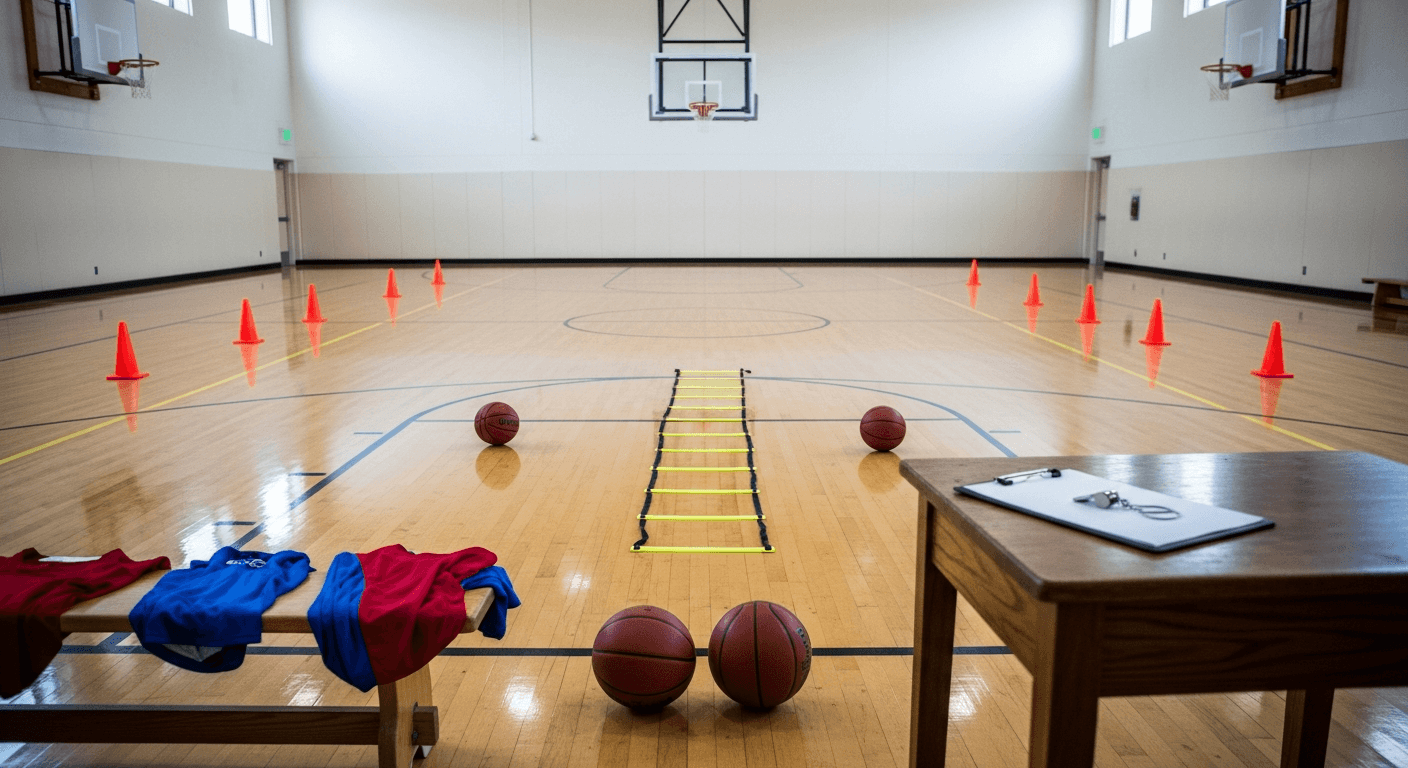
The First Two Practices Aren’t for “Skills”—They’re for Game Readiness
If you coach YMCA basketball, you’ve felt the squeeze: short practices, mixed experience, and a first game that arrives like a pop quiz. You can’t install an offense. You can’t “fix” shooting in a week. And if you try, practice turns into a line-drill museum where kids look busy but don’t get ready.
Big idea: In your first practices, don’t chase “basketball skills” in isolation—build game behaviors. The fastest way to make inexperienced players functional is to teach them what the game keeps asking for: spacing, stopping the ball, finishing layups under pressure, pivoting and passing out of trouble, and transitioning from offense to defense without confusion.
Here’s the coaching cheat code: the game is mostly repeated problems. Your job is to give them simple answers they can repeat—and to practice those answers in small-sided games where decisions are unavoidable.
Coaching law #1: If players can’t do it 2v2, they won’t do it 5v5.
What “Ready for the First Game” Actually Means
Game-ready at this level doesn’t mean “we run plays.” It means your team can survive the first four minutes without melting down. That survival comes from a handful of competencies:
- Transition: sprint back, find a person, stop the ball.
- Spacing: don’t crowd the dribbler; know where to stand when you don’t have the ball.
- Ball security: pivot, pass fake, and make a simple pass under pressure.
- Finishing: make layups at speed with contact and chaos nearby.
- Rebounding & physicality: hit-find-get (or whatever language you use), and don’t watch.
- Communication: talk early, loudly, and about the next job.
Coaching law #2: The first game is won by the team that panics slower.
Practice Design When Time Is Short: Build a “Small Game” Practice
With 12–15 high school players and limited time, your best friend is constraints: rules that force the behaviors you want. Constraints beat speeches. They also create reps without you begging for effort.
Here are practice design strategies that work immediately:
- Start with a competitive warm-up: heart rate up, eyes focused, basketball actions from minute one.
- Progress from 1v1 to 2v2 to 3v3: add complexity only when the previous layer holds.
- Use short rounds: 45–90 seconds, then quick coaching, then play again.
- Coach in “freeze frames”: stop play for 10 seconds, move two players, restart.
- Group by confidence, not friendships: create competitive balance so reps are real.
- Give one correction at a time: one cue per stoppage, then let them play.
Coaching law #3: Your best teaching tool is the next rep.
Coaching Cues You’ll Use All Season (Pick 8–12 and live with them)
These are short enough to shout and clear enough to stick. Use the same language in drills and games.
- “Sprint back, find ball!”
- “Stop the ball first!”
- “Wide corners, big space!”
- “Chin it, pivot!”
- “Jump stop—two feet!”
- “See rim, see teammate!”
- “Hit, find, get!”
- “Talk early, talk loud!”
- “Pass fake, then pass!”
- “Next play—move on!”
- “Hands high, slide!”
- “Paint first, then fan!”
Coaching law #4: If you have 20 cues, you have zero cues.
Six Drills That Make Inexperienced Players Look Coached Fast
These aren’t fancy. They’re functional. They teach the first-game problems directly and repeatedly.
Drill 1: “Advantage Layups” (Chaos Finishing)
Setup: Two lines at half court: offense with balls on the sideline, defense on the opposite sideline. One coach or player under the rim as a “shadow” contest. Use both baskets if you can.
How it works: On the whistle, one offensive player attacks the rim full speed for a layup. A defender chases from behind and must contest without fouling. After the finish, both sprint to the opposite end and join the other line (continuous). Progressions: add a second offensive player for a 2v1; then a second defender for 2v2.
Coaching points:
- Finish off two feet when traffic is near (jump stop into power layup).
- Eyes on the top corner of the square, not the defender.
- Teach body protection: inside shoulder to defender, ball outside.
- On defense, teach verticality and “contest without hacking.”
Why it matters: First games are missed layups and frantic chases. This drill turns chaos into a normal feeling.
Drill 2: “Pivot & Pass Jailbreak” (Ball Security Under Pressure)
Setup: 3 players per group. One offensive player starts on the wing with the ball. One defender plays tight. One outlet teammate stands at the top or opposite wing. Cones can mark a “trap box” (optional).
How it works: Defender crowds the ball. The ballhandler must use a jump stop, pivot (front/back), and get a clean pass to the outlet without dribbling more than once (or zero dribbles for a harder version). Rotate roles every rep. Add a second defender to create a soft trap once they improve.
Coaching points:
- Chin the ball (strong, elbows out legally) before pivoting.
- Pivot on balance: don’t hop and travel.
- Pass fake to move the defender’s hands.
- Outlet shows a target hand and stays spaced.
Why it matters: In YMCA games, pressure defense causes turnovers. Teaching pivots early is like giving them a fire exit.
Coaching law #5: A pivot is a dribble you don’t need.
Drill 3: “3v3 Transition: Stop Ball, Match Up” (No More Fastbreak Panic)
Setup: Three offensive players at half court with a ball. Three defenders start under the rim. Coach stands at half court.
How it works: Coach initiates by passing to offense at half court. Offense attacks 3v3 to score. As soon as the possession ends (make/miss/turnover), the team that defended now becomes offense going back the other way, and the other team must sprint back and match up. Keep it continuous for 60–90 second rounds.
Coaching points:
- First defender back: stop the ball at the top of the key.
- Second defender: protect the paint (no layups).
- Third defender: find a shooter and talk.
- Offense: wide lanes, don’t all run to the ball.
Why it matters: Your first game will have 25 transition moments. This drill gives you 25 transition lessons in 8 minutes.
Drill 4: “Corner-Spacer 4-Out Keepaway” (Spacing Without a Playbook)
Setup: 4 offensive players spaced: two corners, two wings (or wing and top). 2 defenders inside. Use half court.
How it works: Offense’s goal is to complete 6 passes without a turnover. Defenders try to steal/deflect. Offense cannot dribble (or allow one dribble max as a progression). If the ball goes to a corner, that corner must either shoot (imaginary) or pass out within 2 seconds. Rotate defenders frequently.
Coaching points:
- Stay wide: corners are non-negotiable spacing.
- Cut through if you pass and your defender overplays.
- Meet the pass (don’t wait for it).
- Ball moves faster than dribbles—teach them to trust it.
Why it matters: Spacing is the cheapest way to look organized. Four-out spacing gives driving lanes and clearer passing angles immediately.
Drill 5: “Shell to Live: 3 Stops Wins” (Defense That Transfers)
Setup: 4 defenders vs 4 offensive players (or 3v3 if numbers). Start in basic help positions. Coach has a ball.
How it works: Begin with controlled shell movement: pass around the perimeter while defense jumps to the ball, talks, and maintains help. After 4 passes, coach calls “LIVE” and offense can drive and score. Defense stays until they earn 3 stops (stop = forced miss + rebound or turnover). Then rotate.
Coaching points:
- Close out short and choppy, hands high.
- See ball and man (open stance).
- Help early, recover hard—no late hero slides.
- Finish possessions: rebound like it matters.
Why it matters: Kids often “play defense” until the shot goes up—then they relax. This teaches the whole possession.
Drill 6: “Special Situations Scrimmage” (The Stuff That Swings YMCA Games)
Setup: Half court or full court. Two teams. Coach with whistle.
How it works: You run 6–10 quick scenarios, each lasting 20–40 seconds. Examples: baseline out-of-bounds, sideline out-of-bounds, jump ball, end of quarter, down 2 with 30 seconds, up 2 with 30 seconds, free throw box-out. Keep score on execution, not points.
Coaching points:
- Give players one job each (inbounder, safety, rebounder, deny, etc.).
- Teach where to stand before teaching what to run.
- Emphasize communication: call names, point, echo the plan.
Why it matters: The first game will include weird pauses and confusion. You can steal possessions just by being the team that knows where to line up.
Coaching law #6: Organization is a skill.
The Player Archetypes You’ll See (and How to Coach Each)
With 12–15 HS players in a YMCA setting, you’ll get a mix. Coaching gets easier when you stop treating them like identical learners.
- The “Athlete, New to Basketball”: Fast, reactive, foul-prone. Coach with constraints: “No reaching,” “Two-foot finishes,” “Stop ball first.” Praise effort, then shape decisions.
- The “Skilled but Shy”: Can shoot/pass but disappears. Give them scripted touches: start them in a corner for spacing, call their name on the first set, and reward assertive mistakes.
- The “Ball-Stopper”: Dribbles to feel safe. Use no-dribble games and a pass-count goal. Teach them that passing is not giving up control; it’s creating control.
- The “Talker/Leader”: High voice, inconsistent play. Assign communication responsibilities (“You call matchups”). Hold them accountable to do, not just direct.
- The “Chaos Defender”: Gambles for steals. Give them a rule: “Contain first, steal second.” Track deflections AND blow-bys to shape behavior.
Coaching law #7: Confidence grows faster from roles than from speeches.
Common Mistakes Coaches Make in the First Practices (and the Fix)
These are the traps that steal your limited time. Fixing them is like finding extra practice minutes.
- Mistake: Spending 20 minutes on stationary dribbling. Fix: Put dribbling inside 1v1 and 2v2 constraints (one move, attack a cone, finish through contact).
- Mistake: Teaching a full offense. Fix: Teach spacing rules (corners filled, pass-and-cut, drive-and-kick) and let them play.
- Mistake: Running 5v5 too early. Fix: Live in 2v2 and 3v3 until they can defend without constant stoppages.
- Mistake: Correcting everything. Fix: Choose one theme per segment (spacing, transition, pivoting) and ignore the rest temporarily.
- Mistake: Conditioning as punishment. Fix: Condition through competitive games (transition drill rounds, stop counts, rebounding games).
- Mistake: Not teaching out-of-bounds organization. Fix: Install two simple inbounds (one box set, one sideline safety) and rehearse them at speed.
- Mistake: Letting the best players dominate every rep. Fix: Use balanced teams, touch rules (everyone must touch before a shot), and rotate ballhandlers.
- Mistake: Treating turnovers like moral failure. Fix: Label them: “bad decision” vs “bad skill.” Praise the right read even if execution fails.
- Mistake: Ignoring rebounding because it’s “effort.” Fix: Teach technique: hit-find-get, carve space, two hands, chin it.
- Mistake: Talking while kids stand. Fix: Coach on the run: 10-second huddles, quick resets, immediate replay.
Coaching law #8: You don’t rise to the speech; you fall to the habits.
The Psychology Piece: Why Kids Freeze in the First Game (and How Practice Prevents It)
Inexperienced players don’t just lack skill—they lack certainty. The first game adds noise, referees, parents, and the feeling of being watched. That pressure narrows attention. They stop seeing teammates. They dribble into crowds. They forget to match up.
So your first practices should do two psychological things:
- Normalize pressure: timed rounds, scorekeeping, consequences like “loser defends first,” and contested finishes.
- Simplify identity: “We are a sprint-back team.” “We are a wide-spacing team.” “We are a two-hand rebound team.”
Buy-in comes when players feel improvement quickly. That’s why small-sided games are magic: they create visible progress. A kid who couldn’t “play basketball” on Monday can suddenly get a stop in 3v3 on Wednesday. That’s a hook.
One more thing: keep ego safe. Public shaming makes players hide, and hidden players don’t learn. Correct privately when possible, and praise publicly when effort and decision-making are right.
A Coach Moment: The Practice That Looked Great…Until the Game
I once watched a team run perfect three-man weave and beautiful form shooting for 35 minutes. The coach was proud. Parents were impressed. In the game, they couldn’t inbound the ball, got pressed into the corner, and gave up three straight layups in transition. They weren’t out-skilled; they were unprepared for game problems.
The fix wasn’t more weave. It was pivoting under pressure, spacing rules, and transition defense with a stop-the-ball priority. Two practices later, they still missed shots—but they stopped bleeding layups and turnovers. They looked calm. Calm is a skill you can train.
How to Structure Two “First Practices” When You’re Short on Time
You didn’t ask for a minute-by-minute plan, but here’s a practical flow that fits most YMCA time blocks and keeps everyone moving.
- Competitive warm-up (8–10 min): Advantage Layups, continuous.
- Ball security block (10–12 min): Pivot & Pass Jailbreak into 2v1 advantage.
- Spacing block (10–12 min): 4-Out Keepaway, then 3v3 with “corners must be filled.”
- Defense/transition block (12–15 min): 3v3 Transition: Stop Ball, Match Up.
- Finish with a constraint scrimmage (10–15 min): 4v4 or 5v5 with one rule (example: “No shot until paint touch” or “Turnover = automatic sub”).
- Last 5 minutes: One inbounds play + one end-of-game scenario.
That’s not “everything.” It’s the right things.
Game-Day Application: Roles, Subs, and Simple Adjustments
In the first game, your coaching success is mostly about reducing decision load.
Roles: Give every player a simple identity.
- Ballhandlers: “Get us organized, pivot under pressure.”
- Wings: “Run wide, catch ready, drive or swing.”
- Bigs/rebounders: “Protect paint, rebound with two hands.”
Communication plan: Choose three words the whole team uses:
- “Ball!” (who is stopping it)
- “Help!” (paint protection)
- “I got ____!” (matchups)
Substitutions: Sub with purpose, not panic.
- If you’re bleeding in transition, sub in your best sprinters and talkers.
- If you can’t inbound, sub in your calm pivoters and best catchers.
- If you’re getting crushed on the glass, sub in your strongest rebound habits, not your tallest bodies.
Adjustments you can actually make:
- Versus pressure defense: put two players in the backcourt, teach “catch, chin, pivot,” and use the sideline as a friend, not a trap.
- Versus a dominant driver: your rule is “stop ball, protect paint.” Make them shoot over help.
- When your offense stalls: mandate corners filled and a paint touch (drive or post touch) before shots.
And remember: the first game is data. Don’t treat it like a final exam. Treat it like the first scrimmage with referees.
A Second Coach Moment: The Quiet Kid Who Became the Connector
I coached a player who barely spoke and avoided the ball. In early practices, he’d pass and drift toward the crowd like he wanted to disappear. Instead of demanding confidence, I gave him a job: “You’re our corner spacer. Your job is to be wide and ready.”
In 4-Out Keepaway, he started catching cleanly because the spacing gave him time. In 3v3 transition, he learned to sprint wide and become a safe outlet. In the first game, he didn’t score much—but he caught, pivoted, and made the next pass. Suddenly the team had flow. Sometimes the biggest win is turning a “non-player” into a connector.
What to Repeat All Season (Because Repetition Is the Curriculum)
If you only keep a few things, keep these:
- Daily contested layups (two-foot finishes, contact, speed).
- Daily pivoting (chin, strong base, pass fake).
- Daily transition priorities (stop ball, protect paint, match up).
- Daily spacing rules (corners filled, pass-and-cut, drive-and-kick).
- Daily rebounding technique (hit-find-get, two hands, chin).
That’s how you get kids ready for their first games when time is tight and experience is limited: you don’t teach “basketball.” You teach the few behaviors that make basketball playable.
When your players step into that first game and they sprint back, fill corners, pivot out of pressure, and finish through contact, you’ll notice something: the game slows down for them. And when the game slows down, learning speeds up.
Tags
Related Articles
Take Your Coaching to the Next Level
Practice Plan helps coaches create, organize, and share professional practice plans — all in one place, built for coaches.
Free to start • Available on iOS & Web
For Leagues & Associations
Give your coaches a free tool — at no cost to you.
Partner with Practice Plan and your coaches get a 14-day free trial. You just forward one email. No budget, no contracts.
Get Coaching Articles in Your Inbox
Subscribe to receive new articles. Choose your sports to get personalized content.
No spam, unsubscribe anytime.