
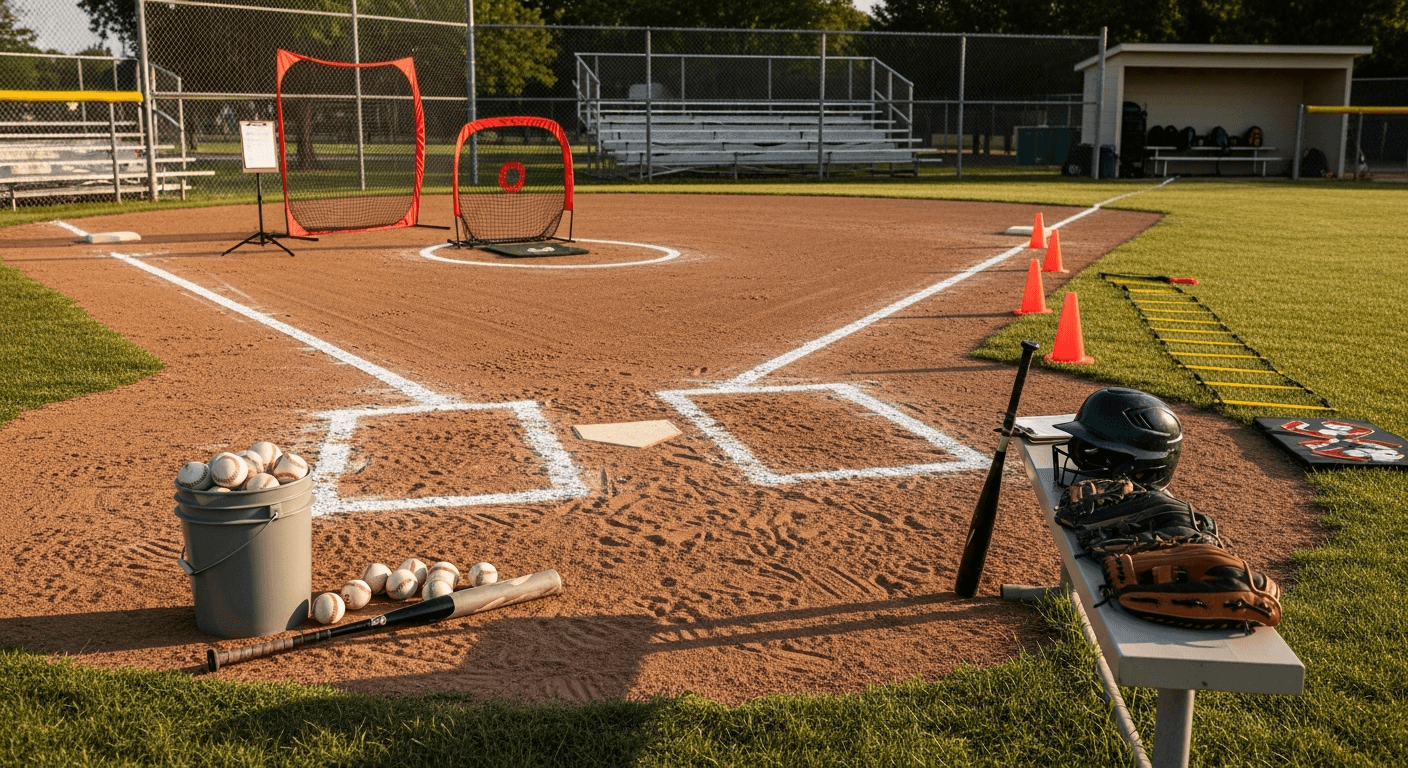
Middle School Baseball: Stop Winning the Wrong Games
Middle school baseball isn’t “small high school baseball.” It’s its own animal: uneven skill gaps, wildly inconsistent throwing accuracy, kids growing into new bodies, and a game that can unravel in one inning because a few routine plays aren’t routine yet.
If you coach it like varsity—tight leash, short bench, “don’t make mistakes”—you’ll probably steal a couple of wins early. But you’ll also create the exact problems that show up in April and May: players who are afraid of the ball, pitchers who nibble because they don’t trust their defense, and lineups full of kids swinging just to survive the at-bat.
The real win at this level is building players who can repeat good decisions under middle school chaos. That means your practices, lineups, and game management have to reward the right things: pre-pitch readiness, simple throwing mechanics under pressure, quality at-bats, and calm execution when the inning gets loud.
This is a narrow-and-deep guide to what actually happens in middle school baseball—and how to coach it on purpose instead of reacting to it.
Realities of Middle School Baseball You Can’t Ignore
If you want to stop “winning wrong games,” you have to coach what the game really is at 12–14 years old. Here are the realities that drive almost every decision you’ll make.
- Most innings are decided by free bases. Walks, hit batters, passed balls, and throwing errors create crooked numbers faster than “big hits.”
- Defense is mostly throwing and catching under time pressure. Ground balls are rarely the problem. The throw is.
- Pitching is mostly strike-throwing and tempo. Velocity matters less than getting ahead and keeping the defense awake.
- Kids don’t fail one play at a time—they fail in clusters. One booted ball turns into rushed throws, then silence, then another error.
- Attention is fragile. If practice has lines, kids drift. If games have long innings, they drift. Your structure has to protect focus.
When you accept those realities, your coaching becomes simpler: you train the few skills that decide most games at this level, and you build the emotional steadiness to survive the inevitable messy innings.
Coaching Laws That Actually Fit Middle School Baseball
These aren’t motivational posters. They’re the rules that keep your season from turning into a weekly roller coaster.
- Law #1: Kids repeat what you reward. If you reward bunting to avoid strikeouts, you’ll get timid hitters. If you reward quality swings at strikes, you’ll get better hitters.
- Law #2: Confusion looks like laziness. If they don’t know who covers second on a ball to right-center, they’ll jog and point. That’s not attitude; that’s uncertainty.
- Law #3: At this level, the “scoreboard skills” are boring. Catch, throw, first-pitch strikes, backing up, and cutoff decisions win more middle school games than trick plays.
- Law #4: Your calm is contagious. If you coach every error like a crisis, you train panic.
- Law #5: Roles reduce drama. Middle school players can handle hard things. They struggle with surprises.
- Law #6: You can’t coach aggression into a kid who feels unsafe. Fear makes them guide swings and baby throws.
Mistake #1: Chasing Runs Instead of Building Run Prevention
Middle school coaches often chase offense because it feels controllable: bunt, steal, hit-and-run, “just put it in play.” But most middle school games are decided by run prevention—the ability to turn routine balls into outs and stop innings from snowballing.
Here’s what “winning the wrong game” looks like in real middle school baseball:
- Offense becomes a trick-play festival because the team can’t string together hard contact.
- Your best athlete plays shortstop forever while other kids never learn the infield clock, footwork, or how to throw on the run.
- You hide weak throwers in right field and accept that opponents take extra bases all year.
- You ride one pitcher because “we need this win,” and everyone else stays unprepared and scared of the mound.
The cost shows up later: you might steal a couple of close games early, but you never build a team that can handle pressure innings because the foundation (catch/throw decisions) never gets trained across the roster.
What to Do Instead: Build a “Run Prevention Scoreboard”
Keep the real score, obviously. But coach the score that predicts your future: the number of plays that should be routine by May.
- Throwing errors: Track “bad throws” separately from “tough plays.” A rushed throw from 3B that sails is coachable. A slow roller with no play is not an error problem.
- Free bases allowed: Walks + hit batters + passed balls. If this number is high, your offense will always feel like it’s chasing.
- Extra bases given: How often did a runner take an extra base on an overthrow or no cutoff? This is a middle school separator.
- First out conversion: When you get a ground ball with a force at 1B, do you take it cleanly and make the throw? Getting the first out stops innings from turning into 7-run disasters.
Tell your team what you’re tracking. If players know you’re watching “first out conversion” and “extra bases given,” they’ll start valuing the boring stuff that wins games at this level.
Practice Focus: The Three Throws That Decide Most Middle School Games
If you only have time to get great at a few throws, pick the ones that show up constantly.
- Infield throw to 1B: Chest-high, on a line, with a clear target. This is the heartbeat of run prevention.
- Catchers throw back to pitcher: It sounds small, but it sets tempo and reduces chaos. Wild tosses back to the mound create distractions, delays, and loss of focus.
- Outfield throw to cutoff: Not to the base—to the cutoff’s glove side. Middle school outfielders overthrow bases. Cutoffs stop extra bases and stop innings from spiraling.
Mistake #2: Turning Practice Into Lines Instead of Rep Density
Middle school baseball practices fall apart when 12 kids stand and watch 2 kids work. You don’t have a discipline problem—you have a rep density problem.
At this age, players need hundreds of throws and dozens of reads per week to stabilize mechanics in growing bodies. If practice is one long fungo line, the kids who need reps the most get the fewest meaningful reps.
What to Do Instead: Design Practice Around the Four Stations You Actually Need
You don’t need a complicated blueprint. You need stations that match middle school baseball’s biggest leaks.
- Station 1: Throwing accuracy under a clock (infield and outfield)
- Station 2: Ground ball footwork into a throw (not just fielding)
- Station 3: Catching/passing ball control (catchers + anyone who might catch)
- Station 4: Quality at-bats (timing, strike-zone discipline, aggressive swings at strikes)
Run 8-minute stations with clear scoring. Middle schoolers lock in when there’s a simple game inside the drill.
Drill: The 60-Second Throwing Test
Purpose: Build accurate throws under mild pressure—the exact thing that breaks down in games.
- Setup: Partners at 60–90 feet (adjust by ability). One target player wears a glove target (or holds a bucket lid/flat cone as a target zone).
- Rule: In 60 seconds, how many throws hit the target zone chest-high?
- Scoring: 2 points for perfect chest-high, 1 point for catchable but off target, 0 for bounce/airmail.
- Coaching cue: “Grip early, show the ball, step to target, finish through.”
Rotate partners and make it competitive. You’ll see immediate improvement in in-game throwing because players learn to control adrenaline and speed up their routine without rushing mechanics.
Drill: Four Corners Infield Clock
Purpose: Teach infielders the difference between “I have time” and “I don’t,” which is where most middle school throwing errors come from.
- Setup: Put a cone at SS, 2B, 3B, and 1B. A coach fungos or rolls balls to different spots.
- Rule: Call out “ONE” (routine) or “TWO” (rushed) as the ball is hit/rolled. On “ONE,” players must use proper footwork and a firm throw. On “TWO,” players must prioritize a quick exchange and throw to a big target.
- Key teaching: Middle schoolers often rush when they have time and slow down when they don’t. This drill flips that.
Keep it moving: 10 balls per infielder, then rotate. The goal is decision-making speed, not perfect fungos.
Mistake #3: Teaching Through Game-Day Frustration
Middle school games are messy. You will have innings where the ball never seems to find an out. When coaches get angry in those moments, they think they’re “raising standards.” What they’re often doing is teaching players to associate mistakes with embarrassment.
And embarrassed players don’t play faster. They play smaller.
In middle school baseball, fear shows up in specific baseball ways:
- Infielders stop wanting the ball: they stand deeper, they hesitate on slow rollers, they “ole” with stiff hands.
- Outfielders play not to get beat: they drift back on everything and give up bloops in front.
- Pitchers nibble: they try to be perfect because they don’t trust what happens if the ball is put in play.
- Hitters expand the zone: they swing at pitcher’s pitches because they’re trying to end the at-bat before it gets worse.
What to Do Instead: Have a Game-Day Script for “Meltdown Innings”
You need a repeatable response when the inning starts to slide—something you do every time so the team feels structure instead of panic.
- Step 1: Slow the game legally. Call time, walk the ball to the mound, and give one cue: “Next pitch: fastball to glove side.”
- Step 2: Reset the defense with one sentence. “We’re getting the next out at first. Routine play.”
- Step 3: Re-anchor your catcher. Tell the catcher: “Quiet body, big target, beat the ball to the spot.” Catchers set the emotional temperature.
- Step 4: Protect the middle infield. If your SS/2B are rattled, simplify: “If it’s to you, take the out at 1.” Don’t chase hero double plays in chaos.
Notice what’s missing: lectures, sarcasm, and public autopsies. Save teaching for practice. Games get short cues.
Practice Tool: Error-Recovery Reps
Purpose: Train the team to respond after an error, because middle school baseball is often decided by the next two pitches after the mistake.
- Setup: Put runners at 1B and 2B (or use cones). Hit a routine ground ball and intentionally call “ERROR” no matter what happens.
- Rule: Defense must execute the next play cleanly: field/throw to 1B, then immediately reset for the next ground ball.
- Coaching cue: “Flush it. Next pitch. Next out.”
This teaches a skill most teams never practice: emotional recovery with immediate execution.
Mistake #4: Pitching Like It’s Varsity
Middle school coaches often manage pitching like they’re trying to win a district title with a deep staff. But middle school pitching is usually a fragile ecosystem: a couple kids who can throw strikes, a few who can throw hard but not near the plate, and several who are terrified of walking people.
“Winning wrong games” here looks like two extremes:
- Extreme A: Ride your one strike-thrower constantly. The team wins some games, but nobody else develops, and your best arm carries stress innings every week.
- Extreme B: Let anyone pitch with no plan. Walks pile up, defense falls asleep, and the game becomes a 90-minute lesson in frustration.
What to Do Instead: Build a Strike-Throwing Program, Not a “Pitching Rotation”
At this level, your staff improves fastest when you standardize a few non-negotiables.
- Non-negotiable #1: First-pitch strike intent. Not “perfect pitch.” Intent. Aim small, throw firm.
- Non-negotiable #2: One fastball location. Glove-side fastball at the knees or thigh. Stop asking for four corners from a 13-year-old.
- Non-negotiable #3: Tempo. Catch the return throw, toe the rubber, sign, go. Tempo keeps fielders engaged and reduces overthinking.
Drill: Three-Batter Bullpens
Purpose: Make bullpens feel like innings, not like endless throwing.
- Setup: Pitcher throws to catcher with a coach calling balls/strikes. Use an imaginary lineup.
- Rule: Pitcher faces three “hitters.” Each hitter gets a 0-0 count. You call a simple plan: “Fastball glove-side until strike one.”
- Scoring: +1 for first-pitch strike, +1 for executing location, -1 for pitch-clock violations (taking too long), -1 for non-competitive balls.
This teaches the two biggest middle school pitching needs: competing in the zone and moving on quickly.
Game Management Tip: Pull Pitchers Before They Lose the Zone, Not After
Most middle school blowups happen when a pitcher’s mechanics slip and nobody intervenes until four walks and two passed balls later. Have a simple checklist:
- Body language changed? Slower tempo, head down, shaking off signs.
- Missing arm-side up? Often means flying open.
- Catcher can’t keep the ball in front? Now the inning is about to become free bases.
Make the move early, and tell the pitcher exactly why: “Your tempo dropped. We’re protecting you. You’ll throw again this week.” That builds trust instead of fear.
Mistake #5: Creating a Lineup That Punishes Development
Middle school lineups can become political fast—especially when a few kids are clearly more physically mature. The temptation is to lock into “the best nine” and never move off it.
But here’s the truth: at this level, the gap between players can shrink dramatically in six weeks if you give the right reps. If you don’t, the gap becomes permanent—because the same kids get all the meaningful innings and high-pressure at-bats.
What to Do Instead: Use Role Clarity and Rep Plans
You can still compete and develop if you’re honest and organized.
- Define three role groups: “Primary,” “Developing,” and “Learning.” Those labels don’t need to be said publicly, but your plan should reflect them.
- Give every player a path: “If you can do X reliably, you’ll earn Y.” Example: “If you can make 8/10 throws to 1B in practice, you’ll get an inning at 3B next game.”
- Rotate with purpose: Don’t randomly move kids. Move them into specific skills: one inning at 2B to learn feeds, one inning at 3B for reaction time, one inning in RF with a cutoff emphasis.
This reduces parent drama because you’re not improvising. You’re developing.
Practical Middle School Defensive Progressions
If you want kids to handle infield pressure, you can’t throw them into shortstop cold in a close game. Progress them.
- Phase 1 (practice): Station work: footwork into throw, glove-to-hand exchange, target throws.
- Phase 2 (scrimmage): Controlled innings where the only goal is “take the out at 1B.”
- Phase 3 (game): Low-leverage innings first. One inning. Clear expectation. Quick feedback after.
Middle school players can absolutely learn infield—if you stop treating it like a reward only the best kids deserve.
What to Emphasize Mid-Season: The Middle School Checklist
Mid-season is where teams either stabilize or spiral. The difference is usually whether the coach doubles down on the basics that decide middle school games.
- Throwing: Daily throwing with targets. Not just “play catch.” Target throws with intent.
- Cutoffs: Outfielders throw to a person, not a base. Infielders line up properly and talk early.
- First out: Take the sure out at 1B. Stop chasing the perfect play when the inning is shaky.
- Catcher control: Block-first mindset with runners on. Quiet glove. Clean exchanges.
- Quality at-bats: Hunt one zone early. Aggressive swing at strikes. Two-strike approach is “battle,” not “bunt.”
If you coach these five areas relentlessly, you’ll notice something: the “crazy innings” become less frequent. Your pitchers throw more strikes. Your defense stops gifting extra bases. And your offense gets better pitches because you’re not constantly behind.
A Simple Practice Template for Real Middle School Baseball
Here’s a practical structure that fits school schedules and middle school attention spans. Adjust time based on your practice length.
- 8–10 minutes: Dynamic warm-up + throwing progression (targets, not just catch)
- 12 minutes: Infield throwing station (footwork into throw, timed reps)
- 12 minutes: Outfield + cutoff station (throw to cutoff glove-side, communicate)
- 12 minutes: Catcher station (blocks, exchanges, throw-down footwork)
- 15–20 minutes: Competitive situational game (first out, one-run defense, runners on)
- 8 minutes: Team baserunning (turns, reads, “freeze on line drive,” tagging basics)
The key is that every block has a measurable outcome: hits target, executes cutoff, gets first out, blocks ball. Middle school players respond to clarity and quick wins.
Closing: Win the Games That Matter First
Middle school baseball will tempt you to coach for the loudest thing: the scoreboard. But the scoreboard at this level is often a reflection of who gave away fewer free bases, not who is “better at baseball.”
If you want to build a team that improves week to week, stop chasing clever offense and start building repeatable execution: accurate throws, calm pitching tempo, clean cutoffs, and a team response to errors that doesn’t collapse.
Win the quiet games: the next pitch after an error, the first out in a messy inning, the throw to the cutoff instead of the base, the first-pitch strike when everyone’s tense. Those are the middle school games that create real baseball players.
Tags
Sources & References
- The Top 6 Biggest Mistakes Youth Baseball Coaches Make
Mistake 1: You Refuse to be a Student of the Game · Mistake 2: You Try to Make Everyone Happy · Mistake 3: You Focus More on Outcome Than Process · Mistake 4: You
- Coaching mistakes and ways to avoid them
Solution – Add variety to the practice agenda. Spending too long on the same drills usually leads to apathy, fooling around, and negative attitudes. Coaches
- The Biggest Youth Baseball Coaching Mistakes and How to Avoid ...
This article explores the most common youth baseball coaching mistakes—from prioritizing wins over growth to neglecting safety protocols—and
- Top 5 BIG Mistakes Youth Baseball Coaches Make ... - YouTube
Coaches - Grab your free Youth Coaching Starter Pack right here: https://www.buildingbetterbaseball.com/coachstarterpack ~ Parents - Grab
- Top 5 Coaching Mistakes That Cost Your Team Runs! - YouTube
Coaches - Grab your free Youth Coaching Starter Pack right here: https://www.buildingbetterbaseball.com/coachstarterpack ~ Want to Dive
Related Articles
Take Your Coaching to the Next Level
Practice Plan helps coaches create, organize, and share professional practice plans — all in one place, built for coaches.
Free to start • Available on iOS & Web
For Leagues & Associations
Give your coaches a free tool — at no cost to you.
Partner with Practice Plan and your coaches get a 14-day free trial. You just forward one email. No budget, no contracts.
Get Coaching Articles in Your Inbox
Subscribe to receive new articles. Choose your sports to get personalized content.
No spam, unsubscribe anytime.