
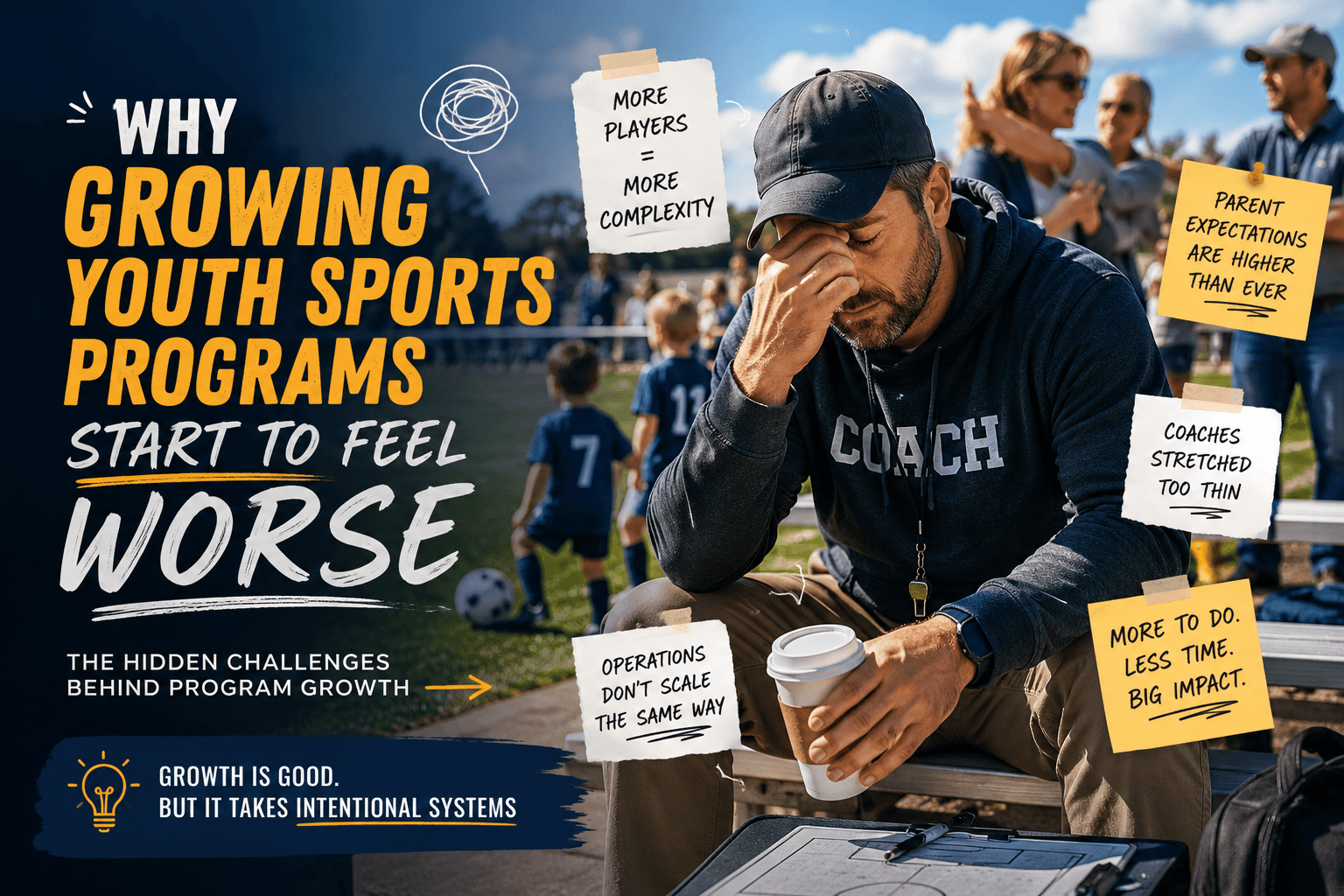
Why Do Growing Youth Programs Feel Like They Get Worse Even When Everyone Cares More?
There’s a specific kind of frustration that only shows up in a program that’s “doing well.” Tryouts have more kids. Parents are excited. You add teams. You recruit more coaches. You start talking about “building a pipeline.”
And then—oddly—everything gets harder.
Not because your coaches stopped caring. Not because your athletes got worse. Not because the sport suddenly changed. It gets harder because growth creates chaos. The moment a program expands, it quietly shifts from “a team” to “a system.” And systems don’t run on effort. They run on alignment.
One team can survive on a coach’s personality, memory, and hustle. Thirteen teams can’t. Thirteen teams require shared language, shared priorities, and shared structure—otherwise you don’t have a program. You have a collection of well-meaning islands.
Big idea (thesis): Most youth sports organizations don’t struggle because they lack passion. They struggle because they haven’t built an operating system for coaching—so every new team multiplies inconsistency, confusion, and wasted time. Practice planning software isn’t about being “techy.” It’s about turning a growing program into a coherent learning environment where coaches can coach and players can progress.
What Kind of Chaos Does Growth Actually Create—On the Field and Off It?
When people say “we’re disorganized,” they usually mean something more specific but harder to name: the program’s information is scattered. And scattered information doesn’t just create annoyance; it creates different versions of reality.
Here’s what growth-chaos looks like in the wild:
- Different fundamentals taught as “the basics” depending on the coach (and sometimes depending on what that coach learned as a player 15 years ago).
- Different terminology for the same concept (“contain,” “shade,” “angle,” “force,” “steer”), so players switch teams and feel like they moved countries.
- Different practice rhythms—one coach does long lines and speeches, another runs small-sided games, another does conditioning disguised as “toughness.”
- Different standards for what “good” looks like, so athletes get mixed feedback and parents get mixed messages.
- Different levels of planning—some coaches arrive with a plan, others arrive with a whistle and optimism.
None of that is evil. Most of it is understandable. Youth coaches are volunteers, part-timers, or teachers juggling a full day already. They’re not failing morally. They’re navigating complexity without infrastructure.
And here’s the sneaky part: the chaos is often invisible at first because each team looks “fine” in isolation. The problem shows up in the transitions—when players move up, when assistant coaches swap roles, when an experienced coach leaves, when the director tries to answer the same questions for the 40th time.
Why Do Program Directors End Up Doing So Much “Coaching” Without Ever Stepping on the Field?
If you’ve ever been a director, you know the job isn’t just scheduling fields. It’s being the human router for every piece of information in the program.
In a small program, that works. You can text a coach a quick practice idea. You can forward a drill video. You can hop on a call and smooth over confusion. But as the program scales, the director becomes the bottleneck.
The director’s week turns into:
- Answering “What should we work on this week?”
- Fixing last-minute practice plans because a coach “didn’t have time.”
- Clarifying what the U10s should be doing versus the U12s.
- Explaining to parents why one team looks structured and another looks like recess.
- Trying to align assistants who weren’t included in the original plan.
That’s not leadership; that’s triage.
And it creates a culture where the program’s “coaching brain” lives inside one person’s inbox. If that person gets busy, sick, or burned out, the system collapses into improvisation.
What Does Consistency Actually Mean Without Turning Coaches into Robots?
“Consistency” is a word that makes good coaches nervous, because it can sound like someone wants to standardize the joy out of coaching.
But real consistency isn’t about everyone running the same drills in the same order like a franchise fast-food kitchen.
Consistency is about shared intent. It means the program agrees on:
- What we teach first (the progression).
- What we call it (the language).
- What good looks like (the standards).
- How we practice it (the structure).
Within that, coaches still get to coach. They still bring personality, creativity, and feel. In fact, structure protects creativity—because you’re not spending your mental energy reinventing the wheel every Tuesday at 4:30.
Think of it like music. A band can improvise because they share a key, a tempo, and a chord progression. Without that, it’s not jazz. It’s noise.
Why Do Players Develop Faster When Coaches Share Language and Progressions?
You can spot a program with alignment in the first five minutes of practice. Not because it’s fancier—but because the players understand what’s being asked.
Development accelerates when athletes don’t have to waste attention translating their coach.
Imagine an athlete who hears one set of cues on Monday and a different set on Wednesday:
- Coach A: “Stay low, keep your base.”
- Coach B: “Bend your knees, hips back.”
- Coach C: “Get athletic.”
All three might mean the same thing. But young athletes don’t automatically map those phrases together. They store them as separate instructions. Now add pressure, speed, and emotion—game day—and you get hesitation.
Shared language reduces cognitive load. It turns coaching into a compounding investment: what was taught at U9 becomes the foundation at U11, which becomes the default at U13.
Shared progression does the same thing. Instead of reteaching “the basics” every year, you build from them. And that’s how a program becomes more than a set of seasons—it becomes a pathway.
What Happens When Every Coach Builds Practice From Scratch Each Week?
Let’s be honest about the weekly reality. Many youth coaches are planning practice in the margins of life:
- In the car after work.
- Between dinner and bedtime.
- On the sideline while their own kid has practice.
When coaches build from scratch every week, two predictable things happen:
First: the practice becomes a reflection of the coach’s stress level, not the team’s developmental needs. If the coach is tired, practice gets simple. If the coach is anxious about last weekend, practice becomes a punishment. If the coach watched a cool drill online, practice becomes a random collection of activities.
Second: the coach starts making “decision debt” payments. Every week requires dozens of small decisions: What’s the warm-up? What’s the theme? How do we progress it? How do we adapt for numbers? What if we’re short on space? What if it rains?
Decision debt is exhausting. And exhaustion is the enemy of good coaching. Not because tired coaches don’t care—but because tired coaches default to what’s familiar, not what’s best.
How Does Practice Planning Software Actually Reduce Chaos in a Growing Program?
Practice planning software sounds, on the surface, like a convenience tool. A nicer clipboard. A digital binder.
But in a growing organization, it can become something more important: a shared coaching infrastructure.
Here’s what it changes when it’s used well:
- Proven plans become reusable assets, not one-time documents lost in a text thread.
- Drills and games become shared vocabulary—not “that one thing Coach Mike does.”
- Assistant coaches get the plan ahead of time, so practice doesn’t depend on one person’s memory.
- Directors can see what’s being taught across age groups without hovering or micromanaging.
- Schedule changes and communication live in one place, reducing the “who told who?” problem.
The point isn’t that software makes you a better coach by magic. The point is that it makes it easier to do the things good coaches already try to do: plan, communicate, align, and iterate.
What Should a Program Standardize—and What Should Stay Flexible?
If you standardize the wrong things, you get resentment. If you standardize nothing, you get chaos. The art is choosing what belongs to the program and what belongs to the coach.
What Belongs to the Program So Players Get a Clear Pathway?
These are the pieces that should feel familiar across teams:
- Season themes (what concepts matter most at each age/stage).
- Core terminology (especially for universal concepts like spacing, leverage, timing, transitions, support, and communication).
- Practice structure (a consistent rhythm: arrival activity, warm-up, skill theme, decision-making game, competitive segment, cool-down).
- Minimum standards (what every athlete should repeatedly experience: lots of touches/reps, competition, feedback, and fun).
What Belongs to the Coach So the Team Still Feels Human?
These should remain flexible so coaches can coach:
- Drill selection within the theme (different groups need different constraints).
- Coaching style and personality (quiet teachers and high-energy motivators can both be excellent).
- Adjustments based on attendance, space, and weather (reality wins).
- Emphasis based on team needs (one team needs confidence; another needs composure; another needs accountability).
Good software supports this balance: it creates a shared spine without forcing every coach to be a carbon copy.
Why Do Kids Look Good in Drills but Fall Apart in Games—and How Does Alignment Help?
This is one of the most common coaching complaints, and it’s usually framed like a mystery: “They can do it in practice, but not in games.”
Often, the problem isn’t effort. It’s that the athlete learned the skill in a context that didn’t match the game—and then got different instructions from different coaches about when and why to use it.
Alignment helps because it allows a program to build decision-making progressively, not accidentally.
Across sports, game performance depends on a few universal abilities:
- Perception: noticing the right cues (space, opponent position, timing).
- Decision: choosing an option quickly enough.
- Execution: performing the skill under pressure.
When one coach teaches “the move” and another coach teaches “the rule,” but they don’t share language or progression, athletes get stuck between mechanics and choices.
A program-wide plan can ensure that younger teams learn simple decision rules (“If X, then Y”), while older teams learn to read more complex cues. That’s not just better coaching—it’s a better learning environment.
How Can Directors Create Alignment Without Becoming the Practice Police?
The fear directors have is reasonable: “If I push consistency, coaches will think I don’t trust them.”
The solution is to frame alignment as support, not surveillance.
Here are practical ways to do that:
- Give coaches a menu, not a script. Provide a set of recommended plans and variations tied to the weekly theme.
- Explain the ‘why’ once, then let the system carry it. A shared progression reduces the need for constant meetings.
- Make it easier to comply than to improvise. If the best plan is already built and shareable, most coaches will gladly use it.
- Use visibility for support. If a coach is struggling, you can help early—before it becomes a parent complaint.
Alignment isn’t control. It’s clarity. And clarity is kind to volunteers.
What Does a Shared Practice Library Actually Do for Coach Development?
Here’s a truth we don’t say out loud enough: many youth coaches are still learning how to coach. They may know the sport, but teaching is its own skill.
A shared library of practice plans and drills does more than save time. It becomes informal coach education.
When a newer coach can open a plan and see:
- What the theme is,
- How the warm-up connects to it,
- How the drill progresses into a game,
- What constraints create the behavior you want,
- What common mistakes to watch for,
…they aren’t just copying. They’re learning the logic of practice design.
Over time, that raises the floor of the whole program. Not by shaming weaker coaches, but by giving them a reliable structure they can grow into.
How Do You Keep Assistant Coaches From Feeling Like Random Extra Bodies?
Assistants are often the most underused resource in youth sports. They show up willing, but without a clear role. The head coach is busy running the session, so assistants drift into ball-feeding, cone-moving, or side conversations.
That’s not an assistant problem. That’s a planning problem.
When practice plans are shared ahead of time, assistants can actually assist:
- They know the theme and can reinforce the same cues.
- They know the stations and can run one with confidence.
- They know the key errors and can give useful feedback.
- They know the competitive segment and can help manage intensity and fairness.
This is where software becomes cultural. It turns “helping” into “coaching,” and it makes the staff feel like a staff.
What Do Parents Notice When a Program Has Structure (Even If They Don’t Know the Sport)?
Parents don’t need to understand tactics to sense professionalism. They notice the experience around the sport.
In a structured program, parents see:
- Practices start on time and have flow.
- Communication is clear and consistent.
- Coaches seem prepared and aligned.
- Kids can explain what they’re working on.
- Progress looks intentional, not accidental.
And when parents trust the process, they’re less likely to micromanage it. That reduces pressure on coaches, which improves coaching, which improves the athlete experience. It’s all connected.
How Do You Implement Structure Without Creating More Work for Coaches?
The fastest way to fail is to announce a new system that adds steps and meetings to already-busy people.
The win condition is simple: the system must save coaches time this week, not someday.
A practical rollout usually looks like this:
- Start with a small set of “gold standard” practices for each age band (early season, mid-season, late season).
- Define a few non-negotiables (shared terminology, practice structure, weekly theme).
- Make sharing automatic (assistants and co-coaches get the plan by default).
- Build in iteration (coaches can leave notes: what worked, what didn’t, what to tweak next time).
Over time, your library becomes your program’s memory. You stop losing good ideas when a coach leaves. You stop reinventing practice every season. You stop relying on the director’s inbox as the central nervous system.
What Should Coaches Do With the Time and Energy They Get Back?
This is the part that matters most, and it’s easy to miss: saving time isn’t the point. Reinvesting attention is the point.
When coaches aren’t scrambling to build a plan from scratch, they can do higher-value coaching work:
- Watch more, talk less. Notice who’s confused, who’s coasting, who’s ready for more.
- Give better feedback. Short, specific cues in the moment instead of long speeches.
- Differentiate. Offer a progression for the advanced kid and a simpler constraint for the beginner.
- Manage the emotional temperature. Keep competition healthy and kids feeling safe to try.
- Connect. Learn what motivates each athlete, especially the quiet ones.
That’s real coaching. And it’s what most coaches thought they signed up for before logistics ate their week.
What Does a Program Look Like When It Finally Has an Operating System?
It looks calmer—not because people care less, but because the chaos has somewhere to go.
Coaches still have freedom, but they’re not alone. New coaches on-board faster. Assistants contribute more. Players move up an age group and recognize the language. Directors stop answering the same questions and start building the next layer of the pathway.
Most importantly, athletes experience something rare in youth sports: a sense that the adults are connected. That the program is bigger than any one team. That practice isn’t just activity—it’s part of a plan.
Growth will always create complexity. That’s not a flaw; it’s a sign you’re doing something right. But if you want growth without chaos, you need more than good intentions. You need structure that scales.
Because the truth is simple: kids don’t develop inside a single practice. They develop inside a system of practices—week after week, coach after coach, season after season. When that system is aligned, development compounds. When it isn’t, you spend your best energy correcting preventable confusion.
Build the operating system, and you give every coach a better chance to do the job they came to do: teach, connect, and help kids grow.
Tags
Related Articles
Take Your Coaching to the Next Level
Practice Plan helps coaches create, organize, and share professional practice plans — all in one place, built for coaches.
Free to start • Available on iOS & Web
For Leagues & Associations
Give your coaches a free tool — at no cost to you.
Partner with Practice Plan and your coaches get a 14-day free trial. You just forward one email. No budget, no contracts.
Get Coaching Articles in Your Inbox
Subscribe to receive new articles. Choose your sports to get personalized content.
No spam, unsubscribe anytime.